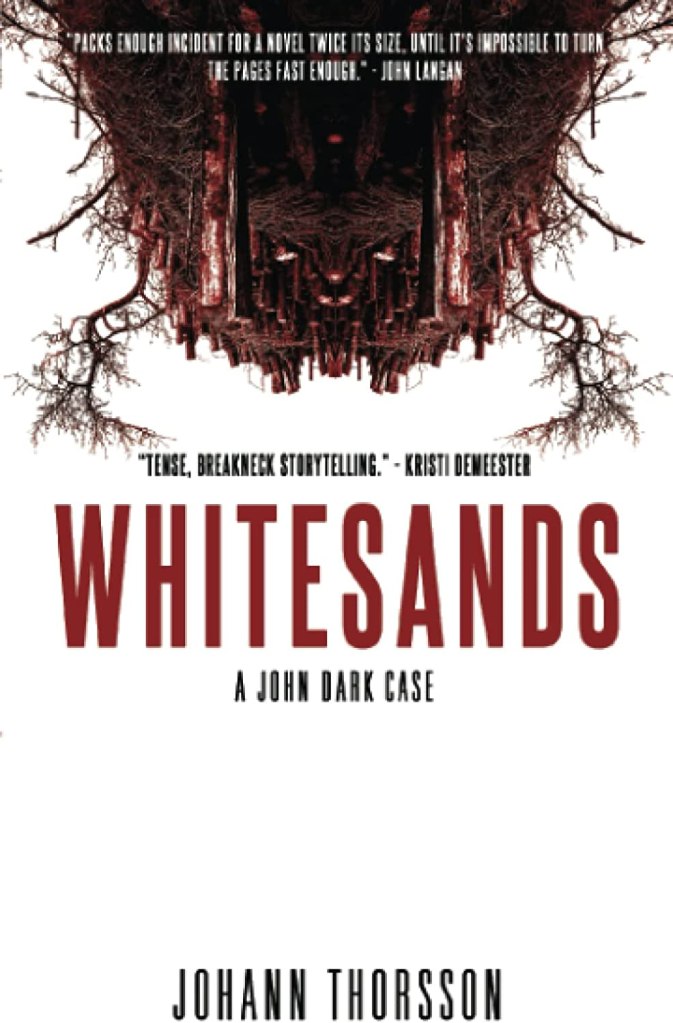
When Detective Kjeld Nygaard is called to the discovery of a body in the burnt-out shell of a house, his heart sinks. He never wanted to see this house again. The house of a notorious serial killer. The house where he rescued Louisa Karlsson from being murdered.
But when they discover the body is in fact Louisa, the mystery deepens. It can’t be the old serial killer. He’s dead.
Then another body is found, again killed in the exact place where Kjeld saved them from another murderer. Another survivor dead.
With the clock ticking Kjeld and his partner Detective Esme Jansson are desperate to stop any more survivors from being murdered. But every clue they find leads to a dead end. Why is the killer picking off people Kjeld rescued? Could it be connected to another of his previous cases?
When Kjeld’s daughter is kidnapped – it’s a race against time to save her life. Can Kjeld stop the killer without paying the ultimate price or will he be the last one alive?
A heart-stopping and gripping crime thriller that will keep you up all night! Perfect for fans of Helen Phifer, Lisa Regan and D.K. Hood.
My thoughts: this was very clever, playing with tropes like “the final girl” and the idea of killers wanting to complete their plan, throwing the detectives off course with cleverly re-staging murder scenes and even getting one death ruled a suicide.
Kjeld’s grip on things is getting weaker, his relationships, both person and professional, are crumbling and he can’t even seem to stop this murderer before they abduct his daughter Tove.
Kjeld is the latest in a long line of detectives with messy lives – and he makes it messier still in this story. We also got a lot more of his partner, Esme, which I enjoyed as she’s an interesting character. The case is a knotty, complex one and I didn’t guess the ending and the killer at all.
*I was kindly gifted a copy of this book in exchange for taking part in the blog tour but all opinions remain my own.
Mission Specialist Adán Fuentes awakes from cryo-hibernation to discover that most of his fellow crewmates are dead and the shuttle Carpathia is not where it’s supposed to be. Surrounded by a vast barren landscape, he and the other survivors wonder how they can accomplish their mission, to establish a home for future colonists.
When an unseen creature attacks them, the Carpathia’s crew must turn their attention to surviving and solving the true purpose behind their mission.
Inspired by the 50’s sci-fi flick FORBIDDEN PLANET, SAND AND SHADOW plumbs the depths of the human psyche and the power of its influence. As the Carpathia’s crew’s secrets and flaws are revealed, readers may find themselves compelled to examine their own dark places.
Excerpt “Hold it here!” Adán jabbed a finger at the corner of the tent still attached. Tink obeyed, gripping the fabric with his gloved hands. Adán grasped the canvas several feet above Tink. Then he began to pull it, gradually drawing the fabric toward him. It was like trying to haul an anchor up from the ocean floor, the effort requiring every ounce of strength he could muster. He wasn’t sure his plan would work. He was battling a storm that at any moment could snatch him up and carry him off. “Get me down!” Scott screamed, his voice piercing through Adán’s comm. “I’m trying! Just hold on!” Adán kept pulling, but he made little headway with the wind pulling so hard in the opposite direction. “Scott, use your hands! Try to climb down!” Scott started hand-over-hand down the column of living canvas. The distance between Scott and Adán slowly began to shrink. The sand pelted Adán so hard now that he could feel it through his gear. “The rest of you get inside!” he called out. “It’s too dangerous out here!” Fess grabbed the heating unit that Scott had dropped and made his way toward the shuttle. Tink held tight to the tent behind Adán. “Tink! I’ve got it! Go on!” “You don’t have it,” said Tink. “I’m not leaving!” “But you have to—” Suddenly, a powerful gust tried to rip the silver tarp from Adán’s hands. The knuckle in his pinky finger snapped in a stabbing flare of excruciating pain, but he did not let go. Scott flipped around in the air, as helpless as a marionette on strings, though he was a good eight feet closer to the ground than he had been minutes before. Adán tried to hold tighter to the fabric, but the pain in his hand throbbed ruthlessly and had robbed it of its strength. “Scott! You’re going to have to let go!” “Let go? Are you insane? This wind will blow me away like a kite!” “Curl up into a ball! Wrap your arms around your knees and drop to the ground!” Adán heard Tink’s voice. “This strap is tearing! When it rips all the way, that tarp is taking you with it, Scott!” “Scott, you’ve got to let go now!” He did. Scott released the fabric and pulled his knees to his chest. He fell like a stone to the sand below. He hit the ground, his limbs sprawling out in every direction. Then, getting to his hands and knees, he scurried away like a bug just as the tarp tore free from its strap. The silver snake curled and whipped like a flag in a hurricane and then vanished into the darkening sky. Adán, his back to the wind, dropped to his knees beside Scott. “You all right?” he asked. “Can you get up?” Scott collapsed into the sand, moaning. Adán felt a wave of relief. Their commander was dazed, possibly even hurt, but he was alive. A few yards off, Tink fought against the storm’s assault. He clutched the transmitter case to his chest and staggered forward one step at a time. The sky was so dark now and the sand so thick that the shuttle looked like nothing more than a broad mass of shadow. Adán slid one of his arms beneath Scott’s shoulder and hoisted the barely conscious commander into a sitting position. “Dryker, listen to me! We’ve got to get back to the shuttle or we’ll die out here! Get up, Commander! On your feet!” Scott moaned again, but Adán felt his muscles stiffen as he attempted to get his legs under him. With a bit of effort on both their parts, Scott was soon standing, though he leaned much of his weight against Adán. Adán looked back at Tink, who hadn’t made as much progress as he’d hoped. “Tink, drop it!” Adán shouted. Tink shook his head furiously. “We need it to communicate with the other shuttles! They’ll never find us without it!” Tink’s words came back to Adán broken and staccato. He tapped on his earpiece. The storm had damaged his comm. “Tink? Can you hear me?” This time Adán heard only static. He looked back to the shuttle, a mere ten yards away. Dema and Fess, clinging to each other, were scrabbling for the hatch lever. Adán looked back at Tink, half that distance behind him. He’d get Scott to safety, he decided, and come back for Tink. “I’ll be back to help you in a second!” he said, though he couldn’t be sure if Tink had heard him, then he trudged forward with Scott in tow. The two minutes or so that it took for him to hand Scott over to Dema and Fess felt like hours. He was exhausted and in pain, but Adán turned and headed back out for Tink, now on his knees hunched over the transmitter just four or five yards away. He had just reached him when Adán saw it—a dark mass rising up from the ground behind Tink. “What the hell is that?” he said more to himself than to anyone else. Dema’s voice crackled over the comm. “Adán, do you read me? Scott’s okay. A bit stunned but okay. Fess is with him in the common room now. Do you have Tink and Lainie?” Lainie. Adán had forgotten all about her. But Tink. . . “There’s something out here!” said Adán. There was a pause before Dema’s voice returned. “Adán, get out of there. The sensors are picking up something solid, something big!” He reached Tink and pulled him to his feet. Together, with the transmitter still clutched in Tink’s arms, they staggered toward the shuttle, which they could now barely make out through the thick haze of sand. “Lainie!” Adán waited a moment for a reply. “Lainie, do you read me?” He shook his head. “The storm’s interfering with the frequency!” “She was carrying the generator,” said Dema, her words nearly impossible to make out through the static. “She was closer to the shuttle than we were. You should see her!” Adán and Tink continued trudging forward. Then just to right of the shuttle hatch, they spotted something square and black half buried in the sand at their feet. It was the generator tipped onto its side, but there was no sign of Lainie.
Laurisa White Reyes is the author of the SCBWI Spark Award winning novel The Storytellers and the Spark Honor recipient Petals. She is also the Senior Editor at Skyrocket Press and an English instructor at College of the Canyons in Southern California.
My thoughts: this was a nicely creepy monsters in space story. The sand monster is out to get the crew and the seven survivors must work together to stay alive – and save the human race.
I liked the way that most of the characters were decent people dealing with a horrific situation they were not prepared for, that had gone way beyond what they thought they were expecting. The book played with lots of sci fi tropes – the uninhabited planet, the terrifying creature, the disastrous mission with no way back, very nicely.
*I was kindly gifted a copy of this book in exchange for taking part in the blog tour but all opinions remain my own.

ORNA ROSS is an award-winning writer, an advocate for independent authors and other creative entrepreneurs, and “one of the 100 most influential people in publishing” [The Bookseller]. She writes novels, poems and nonfiction guides for creatives, and is Founder-Director of two popular online communities, the Alliance of Independent Authors (ALLi) and The Creativist Club. She lives in London and writes, publishes and teaches around the globe. When not writing, you’ll probably find her reading.
My thoughts: I’ve spent a lot of time studying the early 20th century – the First World War, the Russian revolution, but curiously never the Easter Rising of 1916 in Ireland and the turbulent events that followed. It doesn’t even get mentioned. Which is weird considering how many people I know with Irish parents and grandparents, North London has a huge Irish community, but we learnt virtually nothing about our nearest neighbour and the first victim of the British desire for empire.
“The Irish Question” goes all the way back to the Tudors, Henry VIII was Lord Lieutenant of Ireland (a job Churchill would later hold during the 1920s, when parts of this book are set).
Moving back and forth in time, Jo slowly unravels the secrets and sadness hidden in the heart of her family. Her grandmother’s fervent Republicanism, the tragic death of her brother Barney, the suffering of Auntie Norah, and why her mother was so horrified when she fell in love with Rory O’Donovan.
Jo’s relationship with her mother – Mrs D, is fraught with barely concealed anger, they’re so alike they clash constantly, and the past continues to intrude into their lives. The history that shaped the Republic of Ireland also shaped the family, and left them with wounds that haven’t healed.
Jo is fiercely independent and it is only when going through the letters and diaries her mother bequeaths her, finding out how the turbulent years of the early 1900s impacted her family so directly, that she starts to realise that it’s ok to need people, like her sister Maeve.
Book three, In The Hour, is due out next year and fills in more of the missing story of Jo’s family, this time of her absentee father. This is an epic and powerful, moving family saga, that is also an incredible history of Ireland, something that should be more widely taught and learnt from.
*I was kindly gifted a copy of this book in exchange for taking part in the blog tour but all opinions remain my own.

Thea Mottram is having a bad month. She’s been let go from her office job with no notice—and to make matters even worse, her husband of nearly twenty years has decided to leave her for one of her friends. Bewildered and completely lost, Thea doesn’t know what to do. But when she learns that a distant great uncle in Scotland has passed away, leaving her his home and a hefty antique book collection, she decides to leave Sussex for a few weeks. Escaping to a small coastal town where no one knows her seems to be exactly what she needs.
Almost instantly, Thea becomes enamored with the quaint cottage, comforted by its cozy rooms and lovely but neglected garden. The locals in nearby Baldochrie are just as warm, quirky, and inviting. The only person she can’t seem to win over is bookshop owner Edward Maltravers, to whom she hopes to sell her uncle’s book collection. His gruff attitude—fueled by an infamous, long-standing feud with his brother, a local lord—tests Thea’s patience. But bickering with Edward proves oddly refreshing and exciting, leading Thea to develop feelings she hasn’t experienced in a long time. As she follows a thrilling yet terrifying impulse to stay in Scotland indefinitely, Thea realizes that her new life may quickly become just as complicated as the one she was running from.
My thoughts: this is a rather charming rom com set in a small Scottish town. I loved Thea, she was so funny and relatable. Who hasn’t, when it’s all going wrong, longed to inherit a house, money and a library miles away and get to start over?
I liked Thea’s friends, the locals, even the bickering Charles and Edward, especially Edward. Supposedly grumpy but secretly charming.
A really fun, enjoyable read.
*I was kindly gifted a copy of this book in exchange for taking part in the blog tour but all opinions remain my own.

Jedediah Smith, Luke Lin, David Bondsman and Rick Saundersson have created the most innovative bicycle drive in history: The Spinner, a technologically advanced device that produces and stores its own energy without using batteries. It’s 2011, and it’s ideally positioned for the just-emerging city bike market, and the world’s largest bicycle maker located in Taiwan is interested. Just before they are to leave for Taipei to discuss a licensing agreement with Joyful Bike, Luke is struck down while cycling and killed by a hit-and-run driver. Although heartbroken, the three friends decide to continue with their business travels, taking Luke’s fiancée Suzie Sun with them. At Tokyo’s Narita International Airport, the group encounters two Japanese agents of business espionage who don’t know what they have, but nevertheless want to steal it. The “information worms” pursue the cyclists to Taipei, where the stakes grow even higher and a battle of espionage ensues. The guys begin negotiations with Joyful’s director of business development, Jung-Shan Lai. She takes them cycling on Joyful bikes through Taiwan’s breathtaking scenery as they continue to thwart the attacks of the information worms. Jed promptly falls in love with Jung-Shan, and she with him. Will the team be able to secure and finalize their business deal with Joyful Bike? Will the agents of business espionage ride away with the stolen bicycle drive intelligence? Will the three friends get justice for Luke’s tragic death? Will Jung-Shan and Jed work out their cross-cultural love affair?
An eclectic mix of genres, Bridge Across the Ocean breaks through fiction stereotypes, thanks to the author’s engaging story that opens the door to a diverse readership. Bridge Across the Ocean by Jack B. Rochester is anaction-packed, adventurous story fraught with its share of suspense and what-happens-next, IP espionage, business and technological innovation, and a moving love story. An avid cyclist for more than 30 years, author Jack B. Rochester combines his love of cycling with his love of writing in his fourth novel. “This is a book about love,” he says. “It’s a story about four intelligent business innovators’ love of bicycles and cycling; the love by all parties of technological innovation; and a love between two people and the importance of unconditional love between all people.” To support his message and bring awareness to cycling safety, Rochester will be donating all royalties from Bridge Across the Ocean to organizations promoting bicycling safety.
As a grad student, JACK B. ROCHESTER longed to see a book with his name on the cover. Today, it’s on 16 books and counting. He launched his career as a business book editor and guided 65 authors’ books into print. With the publication of the bestselling The Naked Computer, he launched his editorial services company, Joshua Tree Interactive. He wrote three college textbooks and many more business books until 2004, including the publication of his nonfiction swan song, the internationally acclaimed Pirates of the Digital Millennium, co-authored with John Gantz. In 2007, Rochester turned to writing fiction full-time. His Nathaniel Hawthorne Flowers literary trilogy was published by Wheatmark (available in paperback, Kindle, Audible). He’s currently working on two distinctly different novels and a short story collection. You can follow his writing and read his alternating blogs, Saturday Book Review and My Brain on Grape-Nuts, at JackBoston.com, his innovative website. Today, Rochester spends a lot of his time mentoring writers, counseling writers one-on-one and in writing workshops across the country – er, the internet. With Caitlin M. Park, he’s the co-founder of The Fictional Café, an online ‘zine publishing fiction, poetry, creative nonfiction, fine art, photography, and fictional podcasts for nearly 1K subscribers in 67 countries. The Strong Stuff: The Best of Fictional Café, 2013-2017 was published in a limited edition in 2019. A new edition featuring work from 2018-2020 will be published soon. Rochester earned his Master’s degree in Comparative Literature from California State University, Sonoma. He grew up in South Dakota and Wyoming, and spent 15 years on the West Coast. He and his wife split their time between Boston, MA and Florida. An avid cyclist, he owns five bicycles. As he likes to say, no moss grows beneath his feet.
Video from the author
Giveaway – to win a copy of Bridge Across the Ocean, just answer this question below: which character’s death happens just before the planned trip to Taiwan? (US only, book will be sent by the publisher directly to the winner, closes 17th September)
After breakfast, the four went back to their rooms to change into their cycling clothes. Jed, entering the hotel lobby, found Jung-Shan in Team Joyful pink-trimmed black cycling shorts and a pink-and-mauve jersey. She looked at him over her shoulder, then turned to face him and smiled. She was breathtaking to behold, her feminine curves gracefully pronounced by skin-tight spandex. “Not polite to stare, Jed,” said Jung-Shan, giving him a coquettish smile. “Where is yours?” “My . . . mine? My what?” he spluttered. “Your helmet. Your gloves.” She pointed at a table. “Oh, look! They are right here. You see, I am taking care you.” She gave him a mischievous grin. “Ah, yeah,” he stammered. “Thanks.” Holding the door open, she said, “The others are waiting for their captain outside,” delighting in the effect she had on him. Jed grabbed his helmet and gloves and hurried past her.
Wei-Ting drove them from the Serenity Garden inn to Longshan Riverside Park to begin their day’s ride. The early August morning was already hot and quite muggy, but once the bikes were rolling the riders cooled right down. Following Jung-Shan’s lead, they pedaled the wide paved bikeway north alongside the Tamsui River, warming up, getting a few muscle kinks stretched out. All around them people walked, pushed strollers, sat on benches smoking, gazed at river boats, practiced the ancient Chinese movements known as Taijiquan on the lawns. Cyclists of every ilk rode bikes of every ilk: kids on BMXs, women on rusty clunkers with wire baskets filled with fruits and vegetables, young men on racing bikes streaking along, teenaged girls pedaling in twos and threes, three-wheeled bike-carts transporting cartons of commerce and who knows what else, all cruising along with utter disregard for a left-right traffic flow. They rode northwards, following the river, feeling the travel tension diminish. The bikes were performing flawlessly. David said, “Hey guys, what do you think of the carbon fiber?” Jed and Rick raised their fists in approbation. “I think we ought to look into this when we get back home.” Jed said, “I keep saying this! I don’t know why we haven’t already.” “But I told you, a CF fab shop is gonna cost a lot of money,” said Rick. “It’s a whole different process. Lots of handwork.” David said, “That’s true, Rick, but the cycling world is moving toward CF and we ought to, too, before we become heavy-metal dinosaurs. I remember seeing the first CF bike back in the mid-eighties. A Kestrel, I think. A few guys in the MIT Cycling Club had ‘em. In fact, I rode a guy’s once, a Specialized. I wasn’t overly impressed at the time, but this Joyful bike is turning my head.” Jed smirked to himself, Yeah, like Jung-Shan is turning mine. She rode breakaway, five to ten meters in front of the guys, but always close. Her long hair, pulled into a ponytail, fanned in the breeze at her back. Jed had no trouble keeping his eyes on her. They drew deep breaths to oxygenate their blood, all the while laughing, swilling water, grabbing the lead from one another while taunting the others to catch up, but never once getting ahead of Jung-Shan. They rode through Yanping Riverside Park, where fully clothed people lay sunbathing on the manicured lawns. A young guy with long hair flew a radio-controlled helicopter with great skill, making it dive and swoop and climb, flipping it to hover upside down. A photographer with several cameras slung around her neck shot pictures of three college-age kids, two girls and a guy, wearing matching team kits as they stood astride their bikes. They rolled on, crossing the Tamsui on a bridge ramp designated for bicycles. Rick called out, pointing ahead, “Hey, Jung-Shan, isn’t that the Grand Hotel?” She raised two fingers in a V and wagged them. Yes. They rode kilometer after kilometer along the Tamsui until they reached the bright red double-arched Guandu Bridge. Traffic was heavy. “Please be careful and stay in one line behind me,” Jung-Shan called out. They crossed to the east side of the river and turned north on Longmi Road, stopping at a rest area on the Gold Coast Bicycle Path where food stands congregated in a grove of banyan trees. Outdoor toilets designed for a person and their bicycle stood nearby. Rick said, “I gotta take a picture of this!” They continued riding through the Mangrove Preserve, crossing over little wooden bridges, the swamps below filled with birds, sharing the trail with scooters, dog-walkers, jitneys and bikes. Boats of all types navigated the river, shimmering in the bright sunlight. Cruising around the BaLi District, Jung-Shan pointed out the beautiful Hanmin Shrine, where they turned and rode back to the BaLi Pier and took the ferry across the river to the Tamsui District, New Taipei City. The town was filled with interesting shops but the streets grew increasingly narrow, shared equally by cars, scooters, bikes, and jaywalkers. Jung-Shan popped out of her clipless pedals and stopped. “I suggest we walk our bikes.” Even that was difficult: the sidewalks were overrun with tourists, shoppers, scooters. They ate some street food for lunch, little gua bao sandwiches with a slice of pork and a sprig of greens inside, and refilled their water bottles at the 7-Eleven across Zhongyang Road. Jung-Shan said, “If anyone is tired, the Danshui MRT station is near. We can ride the train back to Taipei. Bikes are allowed.” The guys cried “NOT!” in unison. They remounted and eventually were riding north again, heading toward where the Tamsui flows into the Strait of Taiwan. The river was enormously wide here; they stopped to caffeinate at a Starbucks where they could gaze upon its mighty effluence. Jung-Shan, “Come. I will show you something special.” They swung back on their bikes, still heading north, pedaling along a narrow spit of land with the Tamsui on their left. A beautiful bridge came into view on the right. “This is called Damsui Lover’s Bridge,” she said. It was pure white, suspended by cables from a single gracefully curved wishbone-shaped tower. “Ready to go across?” she said, smiling. “We must walk our bikes.” “Why do they call it a lover’s bridge?” asked Rick. “The bridge construction started on a Valentine’s Day,” she said. “I thought I heard you call it Dam-shoey,” said David. “Yes. Often there are many ways to spell in English,” she said. “Danshui, Damsui, all means the same thing as Tamsui. They can sound the same when you speak.” “We have some names like that, too,” said David. “Like, the English spell the name of Köln, Germany, differently than the Germans do. They—we—write it like the perfume, Cologne. I know there are lots of other examples.” “Peking,” said David. “Beijing.” “Tao, Dao,” said Jed. Crossing the bridge, they turned south and rode back to the Tamsui District. Jung-Shan stopped them at the MRT station plaza and said, “OK, if you are warmed up, want to have some fun?” Straddling her bike she tilted her head, grinned, and shook her handlebars back and forth. That got a laugh. “Sure!” said Rick. “What have you got in mind?” “Follow me and you will see!” she said as she clicked back into a pedal and pushed off. They rode a few blocks south, then Jung-Shan signaled for a left turn. There was a fair amount of traffic, discouraging much sightseeing. Soon they were moving away from city congestion on Denggong Road, which became increasingly rural. The road went up and down—more up than down—tracing a route through hills and valleys as it turned south. Then it became steeper, narrower and more twisty. They took a sharp right turn onto Fuxing Road and began climbing in earnest. Homes and Buddhist shrines sprouted out of the thick semi-tropical forest on the mountain slope; no guardrails prevented a sheer drop on the opposite side. Jung-Shan was still leading, constantly downshifting and standing to pedal the more strenuous climbs. Although it was enticing to watch her lithe body in motion—the smooth rise and fall of her pumping leg muscles, the gentle sway of her hips, her beautiful shimmering pony tail dancing behind her—but the guys instinctively knew everyone had to take their turn pacing the ride. They rounded a nearly 180-degree turn and began another steep climb that slowed all four of them. David called out, “I got it,” and jumped into the lead. Jung-Shan got right on David’s rear wheel and began drafting him. “Thank you,” she puffed. They formed a single line and took turns in the lead, one after another, sustaining the wind pocket to help each conserve energy. One rider pumped away for a minute or two, then dropped back for the next rider to lead the paceline. Not only did everyone begin to feel better, but the klicks went by much faster. At last they crested the final mountaintop where they stopped to rest, hydrate and take in the view of the rivers and the vast valley below. “There is Taipei, of course,” said Jung-Shan, pointing. “The small river flowing east to west is the Keelung. We will ride to it. The larger one to the right is our old friend the Tamsui.” “Awesome,” said Rick. “Far away you see the mountains?” she said, pointing east “There is Yangmingshan National Park. I love to go there. Once it was a place of living volcanoes!” She swung her arms into the air. “Many rare flowers grow there. Nice place to stay longer.” She stretched her arms up again, then out, up, and rotated her shoulders. “OK, all ready for the gift of the mountain?” “Gift? What gift?” said Jed. “Every mountain that goes up also comes down. We have now earned our ride down. Please be careful for cars on our narrow road. It is just like the road up. When we reach the bottom, we will arrive in Beitou. It is a nice town with the culture of mineral hot springs for enjoyable health bathing.” “Hey, crazy,” said Rick. “I would love to do that! All us would, right, guys?” “Rick, you are probably only crazy one,” said Jung-Shan, laughing, and they all joined in.
The ride down was exhilarating, scary, fun, both hands on the brake levers all the way. They cruised into busy Beitou, its streets clogged with the usual mix of auto, scooter, bicycle and pedestrian traffic. The guys wanted to linger, just to pedal alongside the hot springs stream and the boardwalk beside it where pretty Taiwanese girls strolled with their colorful parasols, but it was late in the afternoon and Jung-Shan said they should keep going. They followed Daya Road south out of Beitou, eventually crossing a bridge over the Keelung River. They rode a short distance to the Dajia Riverside Park, filled their water bottles and sat on the lawn to rest. Jung-Shan pointed back across the river. “What do you see, Rick?” “Oh, wow, there’s the Grand Hotel again! What a great day! Awesomely great riding and scenery and, wow, just fun!” said Rick. “It’s different here, but it’s not. I don’t know . . . you know?” He looked helplessly at David and Jed. “I think I speak for all three of us,” said Jed, looking at David and Rick, “but Jung-Shan, this Dragon Fire carbon fiber is just, well, I can’t say it in a single word. Your frame design engineering is exceptional. The CF ride’s smooth, really absorbs the road. It handles beautifully; no work. It’s fast, and it responds instantly. I thought our Smithworks bikes were about the hottest bikes on the market, but this Dragon Fire beauty . . . and yeah, it’s beautiful, too. It might be as good as our titanium bike with the same gruppo.” “Maybe better,” said David. “Yep, I would agree,” said Rick, “Maybe. Even. Better.” “So I guess that means we’re in agreement,” said Jed, “we look into carbon fiber when we get home?” They nodded. Turning toward Jung-Shan, Jed said, “What are we doing tonight?” “We are having dinner,” said Jung-Shan. “Sounds good!” said Rick. “I could eat a horse.” “Oh, Rick! You eat horse?” said Jung-Shan, her eyes widening in mock surprise. More laughter. “At dinner we will be joined by Derek.” “To discuss security, I imagine,” said Jed. “No, Jed. I told you before, no business talk while sharing a meal. But I am concerned about what happened at One Path,” she said. “What if we were discovered?” “I’m a little worried about that, too,” said David, “but I have no idea what we can do about it.” “Except wait and see if it happens again, I suppose,” said Jed. “This is not the first time we have had problems with information worms. I have told you this before, too. You will be surprised when you learn how well prepared we are to protect you,” said Jung-Shan, getting to her feet. She brushed grass off her shorts and headed toward the bikes. Jed watched her walk away. Every step. Rick gave him a poke and a wink, and Jed got up. “How long will it take us to ride back to the inn?” David asked as they put on their helmets. “Oh, one hour, perhaps,” said Jung-Shan. “Can you make it?” She smiled, not serious. “Of course we can,” said David. “We’re used to four- and five-hour rides. In fact, we were out on a hundred-miler with major mountaingoat climbs just before we left . . .” The silence that followed spoke for itself. Thoughts of Luke drifted back. Jed replayed the crash scene in his head, a bad, bad movie. He shook it from his thoughts.
Wei-Ting was waiting for them at the Longshan Riverside Park, squatting with two other men, all of them smoking and talking and laughing. He jumped to his feet as they rode up and quickly walked to Jung-Shan. She spoke to him briefly; he nodded, ran to open the Jimmy’s rear hatch and began stowing their bikes. Jung-Shan drew the guys together and said, “Wei-Ting informs me he is confident he has not been followed today. This is a good sign. Perhaps the information worms have not been able to find us after leaving One Path.” “You can just say we shook them off our tails, like American cowboys would say,” said Rick, grinning. “I thank you for teaching that to me, Rick. I’m sure it is simple to translate into Chinese,” she said with a withering smile. “Shook them off our tails.” But they had not.
My thoughts: starting with a shocking event – one that rocks the characters and changes their plans, this is an interesting story about culture clash – between the US and Taiwan, and how we should learn from each other.
There’s also conspiracy and intrigue, corporate espionage, tests to the friendship between the three men and a love story. Something for every reader really. I don’t know a lot about cycling – I own a bike, but couldn’t even tell you what kind (thanks Cycle to Work scheme). But you don’t need to be into the cyclist’s lifestyle to enjoy and appreciate this book at all.
*I was kindly gifted a copy of this book in exchange for taking part in the blog tour but all opinions remain my own.

Holly Mayhew has the perfect family set-up. But when her seven-year-old daughter, Marley, begins to act strangely, refusing to speak and rushing off to hide in her room, she knows something isn’t right.
Desperate to understand why Marley has become so withdrawn, Holly creates a worry box, where Marley posts her thoughts each day.
At first, the messages seem innocent. But when Holly finds a note saying secrets make me sad, she begins to question everyone entrusted with her care…
Including her family.
Once the truth is out… there’s no going back.
My thoughts: everyone in this book is keeping secrets, and they fester, damaging relationships and causing fear and upset. Poor little Marley has it worst, she’s scared that telling her mum what she’s overheard and interpreted, will put Holly in danger.
If this family spoke openly and honestly with each other then they’d all be a lot happier and healthier. Only the baby is immune from this – and that’s because he can’t talk yet!
None of the secrets are as earth shattering as those keeping them think. In fact the most shocking ones actually answer a lot of questions and explain a lot about Holly and Amy’s past. A story about why it’s best to speak up and not keep things hidden.
*I was kindly gifted a copy of this book in exchange for taking part in the blog tour but all opinions remain my own.

She had taken only one step towards the hotel when she heard the car door opening, and then something had her by the shoulders in a grip like steel. Penny tried to fight, but it was no good. The last thing she heard as consciousness drifted away was the whisper of a familiar song…
On a cold night in October a pretty, blonde girl named Penny O’Dwyer is snatched from the quiet main street of a small, coastal town in the west of Ireland. No one saw anything, and a desperate search leads nowhere… Until her abductor sends a video declaring Penny only has ten days to live and a deadly countdown begins.
Criminal behaviourist Jessie Boyle hoped never to work a case in Ireland again. But when her career in London is cut short by a brutal tragedy, she returns to her homeland to grieve – only for her oldest friend to call in a long overdue debt. ‘Help us catch this monster and bring Penny home. We need you, Jessie.’
Throwing herself into the investigation, Jessie makes a chilling discovery: Penny wasn’t the first girl to be taken. As her team find more missing women, she becomes convinced that a serial killer has been hiding in plain sight for years. Nothing seems to tie the victims together, until Jessie realises that that each abduction site is linked to the old Irish myths she read as a child.
Time is running out for Penny, and Jessie’s only hope is to understand the killer’s twisted logic. But he is closer than she imagined… and Jessie is next in his sights. Will she risk everything to save an innocent life?
A totally breathtaking and chilling crime thriller that will keep you gripped to the very last page, perfect for fans of Lisa Regan, A.J. Rivers, Tana French and Lisa Gardner.
Shane Dunphy (S. A. Dunphy) was born in Brighton in 1973, but grew up in Ireland, where he has lived and worked for most of his life. A child protection worker for fifteen years, he is the bestselling author of seventeen books, including the number one Irish bestseller Wednesday’s Child and the Sunday Times Bestseller The Girl Who Couldn’t Smile. His bestselling series of crime novels (written under the name S. A. Dunphy) feature the criminologist David Dunnigan. Stories From the Margins, his new series of true crime books written for Audible, has been critically acclaimed and the second title in the series, The Bad Place, is an Audible True Crime bestseller.
My thoughts: blending ancient folklore with very modern technology and murder, this was a really enjoyable first book in a new series featuring three unconventional investigators – Katie, Seamus and Terri in rural Ireland.
After the daughter of the former Taoseich is kidnapped, the team are put together and sent to investigate. Penny seems to have been leading a double life, legitimate accountant by day, advising criminals and gangsters how to hide their money by night. She also had a steady stream of “friends” visiting her hotel room in the nights leading up to her disappearance.
But Katie is receiving messages purported to be from Celtic myth Balor – a demonic monster. He claims to be involved in the kidnapping. Adding a strange dimension to the case. How does it connect to missing drug shipments from a local gangster? Or to the kidnapping of women over the last forty years?
Really clever and twisted, the team all bring their differing skills to the task, Katie as a psychologist, Seamus a detective, Terri an ace researcher and hacker. I was disappointed to get to the end of the book and realise I’m going to have to wait for the next one.
*I was kindly gifted a copy of this book in exchange for taking part in the blog tour but all opinions remain my own.

Leila Syed receives a call that cleaves her life in two. Her brother-in-law’s voice is filled with panic. His son’s nursery has called to ask where little Max is.
YOUR WORST NIGHTMARE…
Leila was supposed to drop Max off that morning. But she forgot.
Racing to the carpark, she grasps the horror of what she has done.
IS ABOUT TO COME TRUE…
What follows is an explosive, high-profile trial that will tear the family apart. But as the case progresses it becomes clear there’s more to this incident than meets the eye…
A gripping, brave and tense courtroom drama, Next of Kin will keep you on the edge of your seat until the final, heart-stopping page.
My thoughts: this really is shocking and sad – the death of a child always is. But the twists in the final third of the book are the most shocking part. Just when you think the case is closed and the details as disclosed in court, Kia Abdullah delivers some incredible new information, casting a different light over everything you’ve read so far. Very clever, very stunning.
*I was kindly gifted a copy of this book in exchange for taking part in the blog tour but all opinions remain my own.

When Sam Dee moves to the beautiful Wiltshire village of Bishops Well, he expects a quiet life of country walks and pub lunches. OK, so his new neighbour, Maggie Kaye, is a little peculiar, but she’s very nice – and his old pal Richard Ruta lives just down the road.
But when Richard throws one of his famous parties, things take a sinister turn. Sam, Maggie and the rest of the guests are dumbfounded when Richard falls down dead. A horrible tragedy – or a cunningly planned murder?
With a village full of suspects – and plenty of dark secrets – just who exactly would want to bump off their host? Is there a connection to another mysterious death, nearly twenty years before? Armed with her local knowledge, Maggie – with Sam’s reluctant but indispensable help – is soon on the case. But when the body count starts to rise, will sleepy Bishops Well ever be the same again?
Anna Legat is a Wiltshire-based author, best known for her DI Gillian Marsh murder mystery series. Murder isn’t the only thing on her mind. She dabbles in a wide variety of genres, ranging from dark humorous comedy, through magic realism to dystopian. A globe-trotter and Jack- of-all-trades, Anna has been an attorney, legal adviser, a silver-service waitress, a school teacher and a librarian. She has lived in far-flung places all over the world where she delighted in people-watching and collecting precious life experiences for her stories. Anna writes, reads, lives and breathes books and can no longer tell the difference between fact and fiction.
My thoughts: this was a really enjoyable mystery novel – with two amateur sleuths hunting out clues and doing better than the police. Putting little things together, references to Richard’s ‘love of his life, which didn’t seem to be any of his wives, the mysterious woman at the airport, without any access to official equipment or information. But the police are right behind them and can put the murderer away for it.
DI Gillian Marsh is only peripherally involved, as she’s supposed to be on sick leave, but she can’t quite leave it alone. Doesn’t help that Maggie keeps trying to get information out of her about the investigation.
A really fun spinoff from the DI Marsh series, set just up the road from Marsh’s beat.
*I was kindly gifted a copy of this book in exchange for taking part in the blog tour but all opinions remain my own.
Colleen and Andrew haven’t had sex in eleven weeks and three days [not that anyone’s counting]. Their marriage is in crisis, they’re drinking too much and both have secrets they’re afraid to share.
A teetotal week in a remote cottage could solve all their problems. But with the promised beach nowhere in sight, a broken-down car and a sinister landlord, they may not find it so easy to rekindle their romance. In this dark and funny novel, tensions build and tempers fray.
Dan Brotzel’s short stories have won awards and been published widely, with Hotel Du Jack, his first full-length collection, published in 2019. He is also co-author of a comic novel-in-emails about an eccentric writers’ group, Work in Progress (Unbound). The Wolf in the Woods is his debut novel.
Dan lives in London with his partner Eve and their three children.
My thoughts: this is a slightly strange story – mostly because of Wolf, the overly friendly owner of the cottage Colleen and Andrew rent for a week. He’s forever popping in with items of food, some advice, the offer of a lift after their car breaks down, a friendly chat. But he seems to know all sorts of private things about them and becomes increasingly sinister as the week goes on.
Neither Colleen or Andrew are exactly happy, she’s fantasising about running away with Gerry from drama school, he’s too busy cogitating on words and their pronunciation to pay real attention to his marriage. Neither of them want to discuss their problems – the drinking, the estranged son, the fact that they’re miserable.
I’ve stayed in lots of holiday cottages but I don’t remember any of the owners being this visible (except when it was my aunt and uncle’s cottage) and annoying. Wolf and his sister/wife (!?!?!) are really odd too – living in such a remote place, mentioning things but never explaining them – who is Jilly? What’s wrong with Hildy?
This increasingly descends into very black comedy and the beginnings of a horror story where Wolf and ‘Mrs Wolf’ are serial killers or something. The woods are not always full of teddy bears having picnics, sometimes there are wolves…
*I was kindly gifted a copy of this book in exchange for taking part in the blog tour but all opinions remain my own.