blog tour, books, reviews

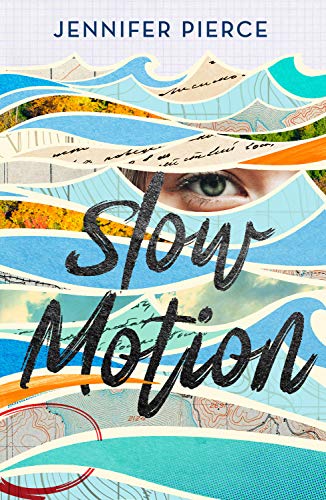
Blog Tour: Slow Motion – Jennifer Pierce*

Westview belongs on a postcard. Quaint, picture-perfect, a tiny New England town steeped in history and traditions.

Angela has always been everything people in Westview want her to be. She’s supposed to be happy here, but she’s starting to see all the flaws in her seemingly-perfect life and she’s afraid that everyone else will notice, too.

Now, she wants something more than small towns, something bigger than the life planned out for her by a family that has designed and destroyed reputations in Westview for generations.

Owen knows that history can be a lot of lies depending on who tells the story and he’s just discovered the truth about how Westview became a drowned town a century ago. But all he wants is to run away from his own past, from the bad decisions he’s made and the tragedies still haunting him. He’s focused on the future and proving people wrong, even though that means keeping secrets from his friends.

Long before they understood the rumours and grudges that rule their hometown, Angela and Owen were friends for one perfect summer.

Now, as they navigate their senior year of high school and Westview celebrates its Tricentennial, they are reunited, discovering truths about themselves, each other, and the ways their community has been shaped by secrets, lies, and a devastating obsession with perfection.

Jennifer Pierce is a graduate of Wheaton College in Norton, Massachusetts, where she earned a degree in Creative Writing & Literature.

Upon graduation, she moved to England to obtain her Master’s in Publishing at Oxford Brookes University. Jennifer has worked with lifestyle websites and academic publishers in Ireland, England, and the United States.

She is currently an Editorial Project Manager at Elsevier and resides in Boston.

Slow Motion is her first novel.

Instagram

My thoughts:

This was a moving and bittersweet novel about growing up and moving on. Realising her home town and life look perfect from the outside, her growing dissatisfaction causes Angela to reevaluate things. She doesn’t want to do what everyone expects her to, doesn’t want to attend the same college her parents did, doesn’t want to spend her life in the small town she grew up in.

A chance encounter with Owen, a childhood friend, adds to her desire to make changes and as she and Owen grow closer, both start to become different people.

Love, friendship and the past collide in this beautiful, lyrical story. The language is soothing and flows well, like the water in the town’s famous reservoir. The images of blue water resonate through the novel, creating a sense of calm waiting to be shattered, like a pool as someone dives in.

A wonderful first novel from an exciting new voice, inspired by her own home town.

*I was kindly gifted a copy of this book in exchange for taking part in the blog tour but all opinions remain my own.

blog tour, books, reviews

Blog Tour: Murder at the Mela – Leela Soma*

Newly appointed as Glasgow’s first Asian DI, Alok Patel’s first assignment is the investigation of the brutal murder of Nadia, an Asian woman. Her body was discovered in the aftermath of the Mela festival in Kelvingrove Park. During the Mela, a small fight erupted between a BNP group and an Asian gang, but was quickly quelled by police.

When Nadia is accused of having an affair with a local man, even more questions about her death arise. Was her murder a crime of passion, or was it racially motivated? Could it be an honour killing? The deep-rooted tensions within Glasgow’s Asian communities bubble to the surface as DI Patel struggles with his parents, who disapprove of his relationship with his Muslim partner, Usma.
As DI Patel struggles to gain any help from the Asian community, another body is discovered in the West End- the body of a white man. Is this new murder fuelled by revenge? Killed by an Asian gang? As the list of murder suspects grows, DI Patel finds himself grappling with the pressures of his new rank, including the racism of at least one fellow officer.
This novel peels away the layers of Glasgow’s Asian communities, while exploring the complicated relationships between Asian people and the city.

Ringwood Publishing Amazon UK

Amazon US Waterstones

Leela Soma was born in Madras, India and now lives in Glasgow, Scotland. She was a Principal Teacher of Modern Studies before deciding to write full time. Her poetry and short stories have been published in a number of anthologies and publications most recently, Issue 5 of Gutter magazine. She won the Margaret Thomson Davis Trophy for Best New Writer 2007 for her then unpublished novel Twice Born which was later published on YouWriteOn. She is on the Committee of the Milngavie Book & Art Festival and the Scottish Writer’s Centre. Her writings reflect her experiences as a first generation Indo-Scot.

Twitter Facebook Website Instagram

My thoughts:

This was a really good crime thriller, looking at the Asian community in Glasgow, both Indian and Pakistani, and some of the issues that unite and divide them, both first and second generation Scots.

DI Patel is the first Indian-Scots inspector in Glasgow CID and he’s determined to do a good job and also encourage an uptake of minority officers. His first big case is the murder of a Muslim bank teller, wife and mother in the park late one night.

The day before had been the Mela, an open air celebration of Asian culture and food, where Nadia had lost her grandmother’s necklace. Hoping to find it, she’d returned to the park and tragically lost her life.

Patel and his team are determined to find the culprit. Sensitive to the religious and cultural issues raised by her death, they investigate the people closest to her.

Well written and engaging, this was a really enjoyable and informative book while also delivering a solid crime novel, with modern diverse Glasgow at its heart.

*I was kindly gifted a copy of this book in exchange for taking part in the blog tour but all opinions remain my own.

blog tour, books, reviews

Blog Tour: The Two Fathers – Keith Dixon*

Read my review of The Cobalt Sky

Why does Jessica Hastings come home late several times a week?

Her husband asks Private Investigator Sam Dyke this simple question. Dyke doesn’t want the case: he doesn’t do divorce work … but Brian Hastings doesn’t want a divorce, he wants an explanation.

When Sam finds out what Jessica is doing, it opens up more questions. And when Brian Hastings goes missing, they’re questions he feels compelled to answer.

At the centre of the mystery is a man who most people in Manchester don’t know—Larry Stone. But those who do know him, know that far from being the simple florist he seems to be, he’s actually the biggest crook in town. He’s powerful, he’s dangerous, and he’s currently working a deal with a Dutchman who’s even worse.

And Sam is now caught in Stone’s sights as he works to find Brian Hastings, to solve a couple of murders, and to prevent Stone corrupting even more members of his own family than he already has.

Before the biggest deal of Stone’s crooked career goes down.

Amazon UK Amazon US

Keith Dixon was born in Yorkshire and grew up in the Midlands. He’s been writing since he was thirteen years old in a number of different genres: thriller, espionage, science fiction, literary. Two-time winner of the Chanticleer Reviews CLUE First in Category award for Private Eye/Noir novel, he’s the author of ten books in the Sam Dyke Investigations series and two other non-crime works, as well as two collections of blog posts on the craft of writing. His new series of Paul Storey Thrillers began in 2016.

Two-time winner of the Chanticleer Reviews CLUE First in Category award for Private Eye/Noir novel, he’s the author of ten books in the Sam Dyke Investigations series and two other non-crime works, as well as two collections of blog posts on the craft of writing. His new series of Paul Storey Thrillers began in 2016.
When he’s not writing he enjoys reading, learning the guitar, watching movies and binge-inhaling great TV series. He’s currently resident in France.

Website Blog Facebook Twitter Email

My thoughts:

Private Investigator Sam Dyke can’t catch a break, manipulated into finding out where Brian Hastings’ wife is sneaking off to, he finds himself involved in a much bigger case, and one that comes with a body count.

Darkly funny, this is an intelligent crime thriller, where no one actually seems to have a plan, least of all Dyke, and chaos thrives. A really enjoyable and clever plot involving florists, a man named Leg, and two rather strange police detectives.

*I was kindly gifted a copy of this book in exchange for taking part in the blog tour but all opinions remain my own.

blog tour, books, reviews

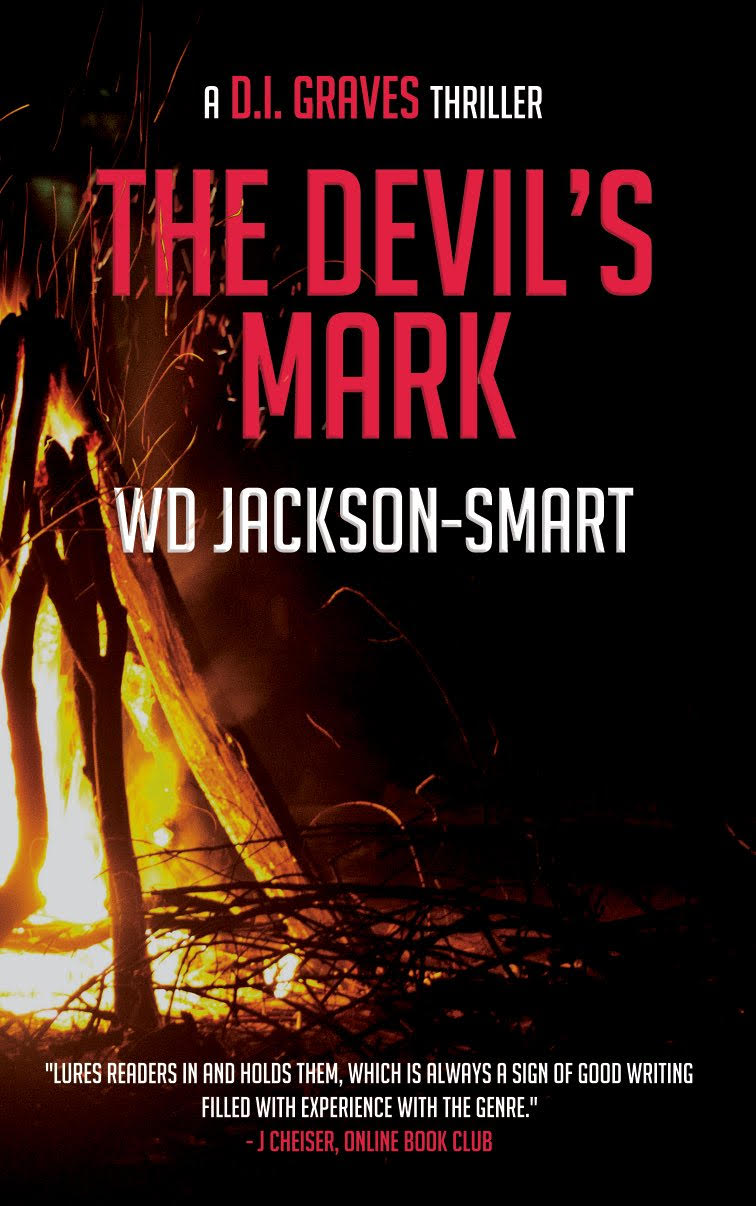
Blog Tour: The Devil’s Mark – WD Jackson-Smart*

Bloody remains. Multiple victims. Ritual sacrifice?

When a blood-stained effigy of body parts is found in a central London park, D.I Daniel Graves must set about trying to discover what it could mean and find the person responsible. Symbols at the crime scene suggest the occult. Who would leave a murder victim in such a way, and why?
As Graves and partner DI Charlie Palmer begin to investigate the ritual and the act of human sacrifice, they enlist the help of Charlotte Gooding, a talented professor specialising in the subject. They hope to narrow down on a motive. Could the killer believe in the supernatural? Witchcraft even?
Then the next crime scene is found. More blood, more symbols, and out in the open. It seems the killer wants the world to pay attention, but why? How are they choosing their victims?
The pressure is on for Graves to put an end to the murders before more remains show up in brutal tableaus. One thing is for sure, this killer is out for blood and is not afraid to make it a very public display.
There’s just one problem. Grave’s past is still not behind him. Someone is eager to make sure he doesn’t forget, cannot move on. And they’re not playing games anymore. There may be an occult killer out there, but now there’s another out for blood, Daniel Grave’s blood.

Panther Publishing

Amazon UK Amazon US

WD Jackson-Smart, 35, is a London-based horror and crime fiction author who has been writing crime and horror fiction since 2011. His novel Red Light was self published on Amazon and charted in the top twenty best selling Suspense / Thriller Kindle books on release.

His horror short story, What’s Yours Is Mine, was shortlisted for the Horror For Good anthology.

His first crime thriller Slasher, about a serial killer targeting slasher movie actresses in Hollywood, is out now, and he has launched a brand new crime series set in London and starring D.I. Graves. The Demons Beneath is the first in the series, and the sequel From Inside The House was published on July 1st 2019.

As well as his passion for horror and crime thrillers in all forms, WD Jackson-Smart also loves art and design, having studied Fine Art and Art History in Leeds and Toronto and working as a graphic designer for the majority of his career.

Twitter Website Facebook

My thoughts:

This was a really good, sinister thriller with the suspects hiding in plain sight at a women’s centre and using modern interest in witchcraft as a cover for some terrible crimes.

DI Graves is running against time, trying to get ahead of the bodies and prevent any more deaths. He’s also started something new with a professor he consulted for advice. Unfortunately his past and possible future are about to collide.

Clever, fast paced and engaging, the multiple viewpoints coalesce as the terror amps up and innocent lives are put at risk. The ending is explosive and takes place in driving rain, hampering the police pursuit of justice.


*I was kindly gifted a copy of this book in exchange for taking part in the blog tour but all opinions remain my own.

blog tour, books, reviews

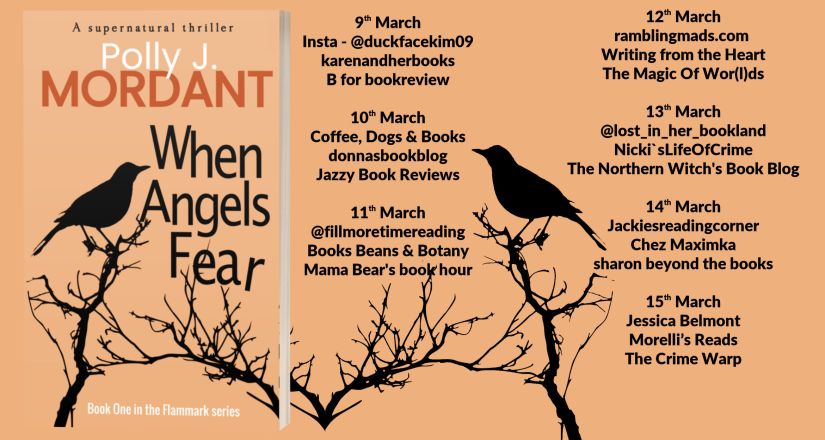
Blog Tour: When Angels Fear – Polly J. Mordant*

She runs from a terrifying past, to a village with problems of its own.

Exhausted, desperately seeking sanctuary, Emma arrives at the pretty English village of Flammark.
But she cannot rest. A strange sleeping sickness stalks the village and a young woman has disappeared.
Why won’t the police investigate?

As events unfold, Emma becomes embattled yet again, compelled to fight for her life against a deadly curse linked to a past about which she had no knowledge.
She is the only one able to vanquish the evil but doing so will entail confronting an horrific and all-too-familiar enemy.

The question is, will she be strong enough?

Purchase

I’ve been writing blogs and stories off and on for years, but quite new to writing novels.
My background is in teaching – I ran my own English and Drama departments in three inner city
schools – then became the owner of a radical bookshop. Now I write full time.

I love supernatural storytelling, since it allows the inclusion of real human issues within my writing.
Let’s face it, who hasn’t been touched by evil in their lives at one time or another? “When Angels Fear”, my first novel, deals with domestic violence and how Emma – the main character – overcomes her shattered confidence to prevail over the evil which oppresses her.

It’s important to me that my characters are both real and relatable. I’m a total fan of Joss Whedon and
Stephen King and love the way they create ensembles of characters that live on in the mind long after they’ve been watched or read. Humour is important to me to – I hope readers of my fiction will get that.
The last thing I want to offer is a dry read!

I adore my garden, my animals and my husband – probably in that order, lol. Other obsessions include Scrabble. Total addict. It’s why I sleep so badly. I’m glued to the Scrabble app until the early hours!

Facebook Twitter Instagram Goodreads Newsletter

My thoughts:

This was an interesting supernatural thriller, an old family curse is at large and determined to claim its next victims. Emma discovers her family’s link to the village of Flammark, and to the curse, after fleeing there from a bad relationship.

Finding new friends, a fresh start and beginning to build her life again is halted by the appearance of her ex and the monstrous curse.

This was a really enjoyable read, with some less than helpful angelic individuals, a determined vicar and two very brave women caught up in something stretching back generations.

There’s also a very confused Detective Inspector with a lot of questions he can’t seem to get straight answers to. I did feel a bit sorry for him.

I can see this growing into an enjoyable and intelligent series, which I look forward to reading as the people in Flammark seem to be a good bunch and there’s plenty of scope for more strange things going on.

*I was kindly gifted a copy of this book in exchange for taking part in the blog tour but all opinions remain my own.

blog tour, books, reviews

Blog Tour: Yearn to Fear – Chas Murrell*

The greatest scientific invention of modern times…
Capable of curing humanity…
But more adept at controlling it…

Sydney scientist, Marcus Hall, is developing a radical 5G Wi-Fi receiver for CSIRO. With access to secretive Lamarr computer chips – this technology promises billions to repair Australia’s ravaged economy. On a caffeine boosted whim, he inadvertently discovers a therapeutic breakthrough in neuroscience. Or so he thinks…

His seemingly trustworthy lab partner, Henry, is an unlikely Australian spy. His official duty is keeping tabs on the project and their Lamarr chips. But the whole project is now classified top-secret.

Marcus remains blissfully unaware of the many secrets surrounding him, until he witnesses the graphic murder of a colleague. Could this event reveal Henry as a master deceiver and ruthless double agent? Will the scientific discovery be fatal for Marcus, those he loves, and the one he yearns for? Marcus faces a soul tearing dilemma: is the only means of stopping the carnage to weaponise his prototype?

Foreign intelligence agencies realise the top-secret breakthrough is priceless. One particular spy leads the race to seize the invention. A psychological master of the long game, espionage, and extortion, his only rule according to Kung Fu: Win.

Friend and foe alike confront this psychotic mastermind. All will FEAR him, but is their FEAR real? Only the next six minutes will tell…

Amazon UK Amazon US Waterstones

Chas Murrell has been a Police Officer, Senior Fire Commander, Customs Coastwatch surveillance mission co-ordinator, heavy machinery mechanic, emergency medical technician/ instructor, film extra, and General Manager of an event company. He has published academic papers on liquid hydrogen and held a worldwide provisional patent for a nonlinear mathematical calculation.

He survived Australia’s largest gas BLEVE in 1987, and has provided operational support to some of Australia’s largest natural disasters in North Queensland.
He has published academic papers on liquid hydrogen and held a worldwide provisional patent for a nonlinear mathematical calculation.

He survived Australia’s largest gas BLEVE in 1987, and has provided operational support to some of Australia’s largest natural disasters in North Queensland.
On a personal level he has suffered from relentless and debilitating migraines all his life, is father to four and pop to two. He and his artistically entrepreneurial wife live in Tasmania, which looks very much like Scotland and they wouldn’t have it any other way.

A direct descendant of Robert the Bruce (King of Scots), history runs deep in Chas’s veins, along with a profound knowledge of both World Wars. You may even come across him online playing World of Tanks.
In his Australian spy thriller books you will get to know Chas’s knowledge of technology, intrigue, crime, espionage, weaponry, banter, romance and even whisky… yet above all, there is believability and no loose ends.

Website Facebook Twitter Instagram

My thoughts:

This was an enjoyable sci-fi spy thriller, although I got a tiny bit confused at one point – but I blame the villain of the piece for that!

The technology Marcus invents could be revolutionary and help sufferers of many conditions or it could be deadly in the wrong hands. Now he, and his friends are in danger.

It was a fast paced, action packed adventure with scientists and spies galore, several double crosses and double agents and someone losing their mind completely while armed.

I liked Marcus and Henry – they were smart and personable, their friends and family too. I could see how their accidental discovery of something they were just messing about with could put them in trouble quite easily. I felt sorry for poor Sarah getting entangled with the ghastly Peter.

I also really liked that the series and the important element in Marcus’ invention is called Lamarr, after the brilliant scientist and actor Hedy Lamarr, a woman often overlooked and forgotten in the past.


*I was kindly gifted a copy of this book in exchange for taking part in the blog tour but all opinions remain my own.

blog tour, books, reviews

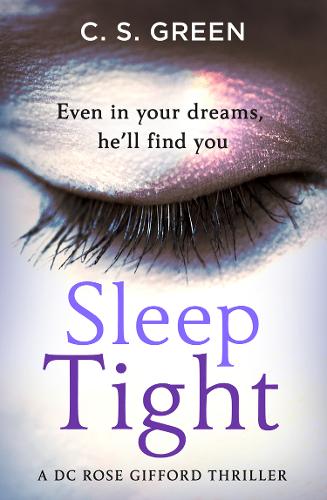
Blog Tour: Sleep Tight – C.S. Green*

Even in your dreams you’re not safe…

The nightmare is only just beginning…

When DC Rose Gifford is called to investigate the death of a young woman suffocated in her bed, she can’t shake the feeling that there’s more to the crime than meets the eye.

It looks like a straightforward crime scene – but the police can’t find the killer. Enter DS Moony – an eccentric older detective who runs UCIT, a secret department of the Met set up to solve supernatural crimes. Moony wants Rose to help her out – but Rose doesn’t believe in any of that.

Does she?

As the killer prepares to strike again, Rose must pick a side – before a second woman dies.

My thoughts:

This started out as a tight, tense locked room murder but then dipped into Rivers of London style territory and became even more weird and twisted and I really enjoyed it.

DC Rose Gifford is contacted by a detective working for UCIT – apparently a compliance team but actually they deal with the weirder cases – ones like this, that might involve a killer who can astral project himself into his victims’ dreams and then into their reality.

What Rose is hiding is that she can see things that she shouldn’t – like her dead mother, and she’s worried if she says anything they’ll think she’s crazy but DS Moody and her team are on the lookout for people just like her – for them seeing the dead is a good thing.

As the case continues Rose has to be brave and dig deeper – it’s just all too neat and tidy, their suspect is too convenient. I liked Rose, her tenacity and nose for the truth, however strange, serve her well in this case.

Well written, gripping and very enjoyable, this is the first in what will hopefully be a series of strange cases solved by the UCIT team with some unorthodox methods, can’t wait!

*I was kindly gifted a copy of this book in exchange for taking part in the blog tour but all opinions remain my own.

blog tour, books, reviews

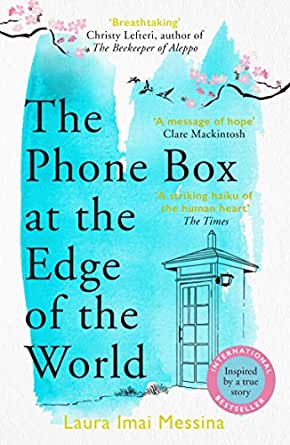
Blog Tour: The Phone Box at the End of the World – Laura Imai Messina*

A sweeping, moving novel based on an incredible true story.

Picture an old disused telephone box in a beautiful garden, not found easily.

When Yui loses her mother and daughter in a tsunami, she wonders how she will ever carry on. Yet, in the face of this unthinkable loss, life must somehow continue.

Then one day she hears about a man who has an old disused telephone box in his garden. There, those who have lost loved ones find the strength to speak to them and begin to come to terms with their grief. As news of the phone box spreads, people travel there from miles around.
Soon Yui makes her own pilgrimage to the phone box, too. But once there she cannot bring herself to speak into the receiver. Then she finds Takeshi, a bereaved husband whose own daughter has stopped talking in the wake of their loss.
What happens next will warm your heart, even when it feels like it is breaking.

When you’ve lost everything – what can you find?

About the Author

Laura Imai Messina was born in Rome, Italy but has been living in Japan for the last 15 years. She works between Tokyo and Kamakura, where she lives with her Japanese husband and two children. She took a Master’s in Literature at the International Christian University of Tokyo and a PhD in Comparative Literature at the Tokyo University of Foreign Studies.

She took a Master’s in Literature at the International Christian University of Tokyo and a PhD in Comparative Literature at the Tokyo University of Foreign Studies. The Phone Box at the Edge of the World has been sold in over 21 territories.
Laura can be found on Twitter and on Instagram, or on her website.
Lucy Rand (Translator): Lucy Rand is a teacher, editor and translator from Norfolk, UK. She has been living in the countryside of Oita in south-west Japan for three years.

My thoughts:

Beautiful and moving, this is a joy to read.

It really captures the terrible loss and pain of those left behind, not just after a major tragedy, like a tsunami, but also after those small ones in people’s lives, the deaths of loved ones.

I liked the little lists of characters’ thoughts and asides, it made them more realistic, as we are all made of those little things. Truly a stunning book.


*I was kindly gifted a copy of this book in exchange for taking part in the blog tour but all opinions remain my own.

blog tour, books

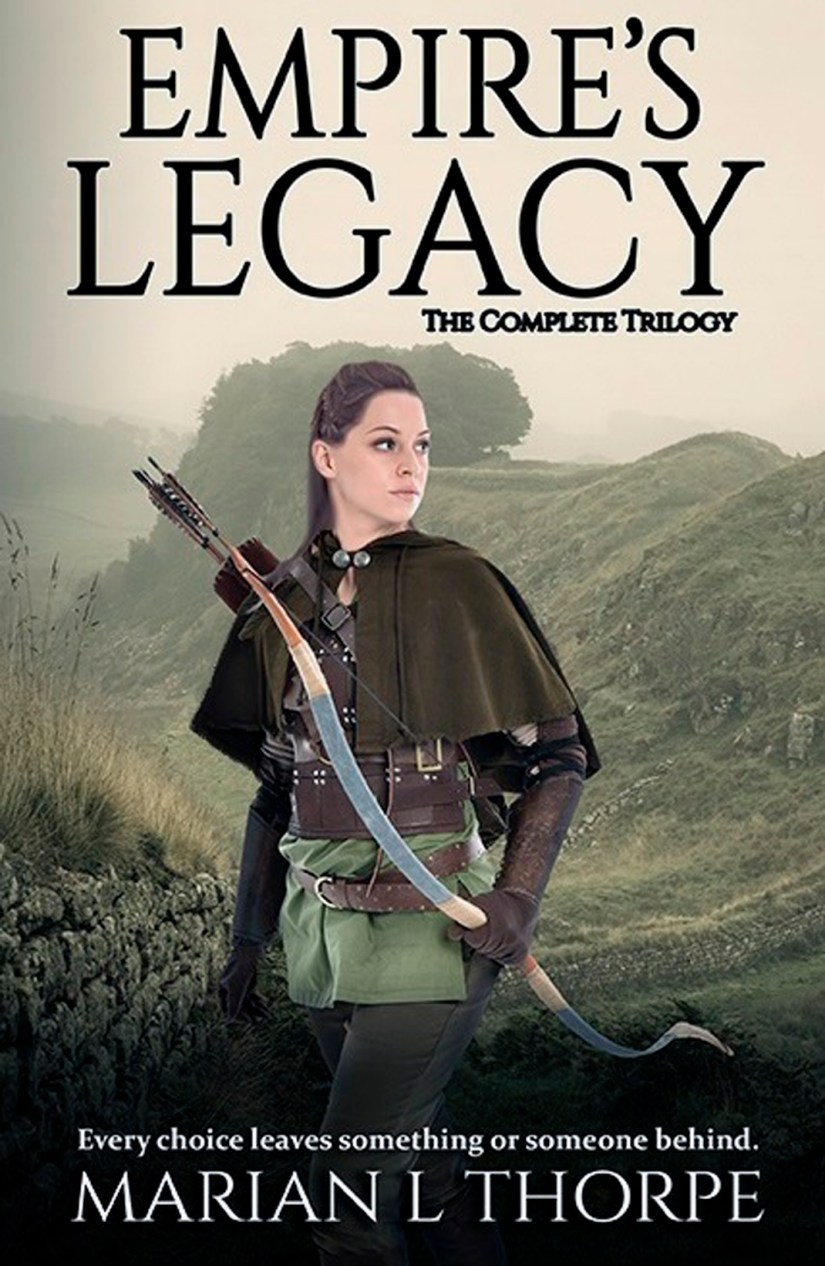
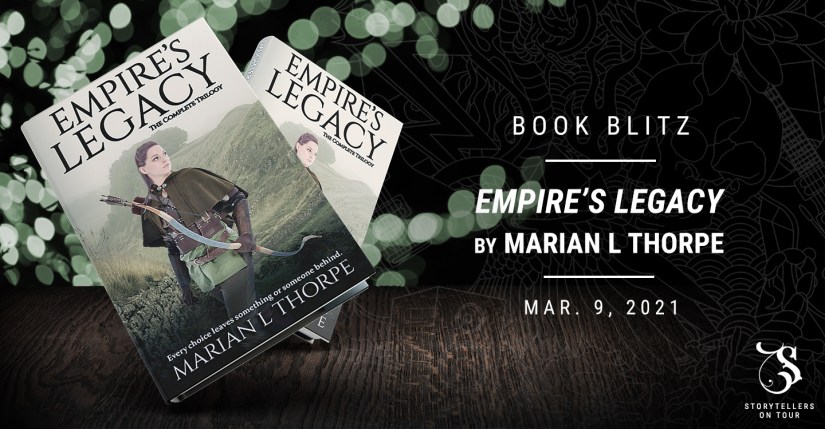
Blog Tour: Empire’s Legacy – Marian L Thorpe*

Lena is a skilled hunter, but beyond the need to kill for food, weapons are a man’s domain – until
one day a soldier arrives in her village, pleading for fighters. Accepting his challenge, she steps
into a new life, one of battle, intrigue and politics, where actions have deadly consequences. Her
survival – and that of her country – depends on her prowess with knife and bow, her quick wit, and
a journey into unimagined lands to confront a lost Empire of immense power.

Goodreads Ebook Paperback

My books are historical fantasy in that they are historical fiction of an imagined world, one that is
close to Britain, Northern Europe, and Rome, but isn’t any of them. A world where a society evolved differently after the Eastern Empire left, where one young fisherwoman answers her
leader’s call to defend her country, beginning a journey into uncharted territory.
After two careers as a research scientist and an educator, I decided it was time to do what I’d always really wanted and be a writer. As well as my novels, I’ve published short stories, both on-line and in chapbook format, and poetry. I’ve done public readings at several juried venues, including
the Eden Mills Writers’ Festival. My life-long interest in Roman and post-Roman European history
provided the inspiration for my books, while my other interests in landscape archaeology and bird-
ing provide background. Walking across England from the Irish Sea to the North Sea with my sister also had a major influence on the Empire’s Legacy trilogy!
I also oversee Arboretum Press, a small publishing imprint run as a collective. Right now, I’m writing Empire’s Heir, the next book in the series.

Website Twitter Facebook
Arboretum Press Vocamus Press
Goodreads

When Fél had led us into the village—if a cluster of huts was a village—we had been fed, clothed,
stared at by children and adults, questioned. Fél, acting as our translator, convinced the headwoman
to give us an empty hut at the edge of the village: it was dilapidated and damp, its mud-and-wattle
walls crumbling, but easy enough to repair. I suggested we simply pitch our tents inside it, out of the
wind. The work of repairing the building seemed too much for a brief stay.
Fél had shaken his head when I proposed this. “There is nowhere for you to go, Lena,” he had said.
“Today’s weather is just the start: snow will come in the next week, and then a hard and killing frost,
turning the ground to iron. And then more snow. Autumn Festival will barely be over in the Empire
when it is winter, here.”
I had not known what to say. I had expected to travel for—how long? I hadn’t thought about
winter, not really, expecting that once we had left the mountains behind we would leave the cold
behind too. I thought how stupid that was: even the grasslands south of Tirvan were fierce and
inhospitable in the winter. But how should I have known to expect a winter that came so soon?
“But can we stay?” Cillian had asked. “Can your people support two more mouths over the winter?”
“You can hunt, can you not?” Fél had replied.
“Yes, for small game,” Cillian answered. “Lena is experienced with larger animals.”
Fél sat back on his heels beside the fire. “The women of the Kurzemë do not hunt. That is a man’s
job.”
“But I will not be a woman of the Kurzemë,” I said. “We need a place for the winter, not
permanently.”
“Where will you go, in the spring?”
“East, across the plain,” I answered.
“Into the dead lands?” he asked. “We do not go far into them, only to a meeting place in the
summer. There is little there to sustain life, and stories of huge bears on the plain.”
I glanced at Cillian. “What lies beyond the mountains and the seas,” I said softly.
“That story?” Fél said. He shrugged. “They are your lives. If you can hunt, you can stay. I will try to
explain, to Grêt, the headwoman.”
“Lena.” He turned to me. “What skills have you, so I can be precise?”
“I fished, at Tirvan,” I said. “I am good with the hunting bow and the bird bow, and I can wield a
sword. And a knife, in warfare or defense.”

“None of which are women’s skills here,” he replied. “Is there nothing you know that belongs to
the skills of women, of hearth or healing?”
“A little of healing,” I said. “My mother was a healer and a midwife, but I was not her apprentice.
What I know is very slight. And all the things I can do are skills of women, in the Empire.”
“Perhaps,” Fél said. “But you are not in the Empire any longer, nor will you ever be again. That may
sound harsh,” he added, “but it is only truth, and a truth which you must accept. So you both must
begin to learn the skills of a new life.” He stood. “I will speak to Grêt.” He turned to go, then hesitated,
looking down at where we sat. “Are you together? Paired?”
“No,” I said. “Travelling companions, friends, nothing more.”
“Better that you let it be thought you are together,” he said, “if you do not want the attentions of
every unmarried man here. Or woman,” he amended, looking at Cillian. “Grêt already assumed as
much when she offered the hut: I suggest you do nothing to change that assumption.”
The hut, built of woven willow branches between upright posts, packed with mud and hair, needed
a lot of repair. Fél brought his wife, Kaisa, and between them they taught us how to weave the
branches and add the mud. Cillian proved adept at the weaving, his long fingers interlacing and twisting the thin branches rapidly and precisely. I packed mud and wool.

Grêt, the headwoman, had made Fél bring me to her. She had listened in silence, then spoke to Fél
for some time. I didn’t think she sounded happy.
“Grêt says,” Fél told me, “she has heard of women like you: you belong to the huntress. She’s a
goddess, here,” he added. “You can keep your weapons and use them, but there will be a price. You
will not mix with the other women, although you will guard them, sometimes. If you do a man’s work,
you must act like a man.”
“Which means?”
“You will be expected to hunt, and guard the sheep, and guard the women if they go far from the
village. There are wolves here, and bears and other dangerous creatures. You will not join in the
women’s rituals.”
Grêt shot another question at Fél. “She is asking about Cillian. Why he would want a woman like
you, who does not tend his hearth and bear him children.”
“Tell her she must ask him.” I wasn’t going to try to invent a story for him.
He walked back to our hut with me. “You will need sleeping furs,” he said. “We have extras; Kaisa
will bring them to you. She will not shun you, but she will need to be careful, or the other women will
shun her too. You are choosing a hard road for the winter, Lena.”
Grêt may have said I would hunt with the men, but the men had other opinions. Especially Ivor, I
learned: he refused to have me with him. Eryl, a man of Cillian’s age who seemed to be in charge after
the aging headman, Ludis, simply shrugged. “You can hunt with me, or Audo,” Fél told me. “I am going
to show Cillian our bow tomorrow; come with us, if you like.”
I considered. Cillian’s status here mattered, too. “No,” I said. “Perhaps I’d better not. Is there
something else I can do?”
“Audo always likes company when he checks his snares,” Fél said. “He’s slow, you realize. Up here.”
He tapped his head. “But you can go with him.”
Two heavy furs lay inside our hut when I returned, dark, shiny fur. Bear? I dragged them over to
the sleeping platform. No-one slept alone here in the winter, Fél had said casually; children were
sent to sleep with the elderly and unmarried youngsters shared beds with brothers and sisters or
cousins. I was glad that Cillian and I were used now to sharing sleeping space. Even a few weeks
earlier, he would have been uncomfortable.
For the first ten days I wondered if we’d made a mistake. The mild days suggested we could have
kept moving. But overnight the weather changed: we woke to find snow up to our ankles, and more
falling. After that, it was clear we had to stay.
Fél continued to act as translator and mentor, guiding us both through the expectations of the
Kurzemë’s daily life. He had taught Kaisa, his wife, some of our common language, so she too could
speak to us, a bit. But, unsurprisingly, Cillian began to learn the language quickly, and when at night
we discussed what we’d learned about the Kurzemë, he taught me new words, so that I too began to
understand what was said and could ask and answer questions.

Cillian had adapted to the larger hunting bow with ease. For someone who hadn’t touched a bow
until only a few months earlier, he had become proficient rapidly, to my private chagrin: I thought
he might be as good as I was, and I had taken years to be skilled. He joined the hunting parties
regularly, for deer at this time of year. The carcasses were brought back to be butchered by the
women, the meat being smoked for winter food. I could help with this, and did, to Grêt’s grudging
approval. I had no skill in working the hides, although my secca, sharper than the women’s knives, proved useful in cutting the skins.
The grain harvest was another place I could contribute, joining in stooking and tying grain:
scything was a skill I had never mastered. Nor could Cillian, to Ivor’s derisive laughter, although I
noticed he found reasons not to spend much time at the hard, back-breaking work. Even children
gleaned grain from the cut fields, the older boys killing both the rabbits and rats that lived among
the stalks with well-aimed stones thrown from leather slings. As at Tirvan, the autumn hunt and
harvest were a time of communal labour, punctuated by evenings of food and merriment. It had a
familiar feel that both reassured me and made me remember what I had lost.
Only one thing, or rather, one man, made me truly uncomfortable. I could handle being an outsider,
not really accepted by either the women or the men. Ivor, however, was another matter.
The problem had begun with guarding the sheep. Eryl led the guard; Ludis was too crippled and
infirm now. He had asked me to join the men near the sheep pens one afternoon: a wolf had been
seen, unusual at this time of year. He strode up beside me, his broad, open face smiling. He carried
two bows and two quivers of arrows.
“Grêt tells me you are to guard,” he said. “I thought, maybe Lena needs a bow. I know you have
one, but it is meant for birds, yes? So I brought one for you to use.”
“Thank you, Eryl,” I said. “That was thoughtful.”
“You should shoot it a few times, get used to it,” he suggested.
“I will,” He was right: with an unfamiliar bow, I wouldn’t be much use. Several other men and a
couple of older boys had grouped themselves around something on the hillside. One of them, I saw
with an inward shiver, was Ivor.
“Eryl, here,” one called. I followed him over to where the men stood. Eryl crouched in the dusk,
looking at the ground. “Wolf scat,” he said, “fresh this morning. A young one, probably, pushed out of
its pack.” He turned to me. “Have you ever seen wolf scat, Lena?”
“No,” I said, “I haven’t. All the wolves had been cleared out of our part of the Empire, although
older women had stories of them raiding our sheep, too.” I crouched beside him, ignoring the other
men. This was information I needed, and Eryl was the best tracker in the village. “How do you know
it’s wolf scat, and not dog?” One of the boys made a derisive sound.

“Mostly from the little bones in it, and the amount of fur. And it comes to a point, see? Dogs shit
more like people,” he said, “or at least like people when there’s lots of meat to eat.” He turned his
head back and forth. “The wind is off the mountains, so expect it to circle around, come at the sheep
from below. I want good archers down that side. You, Ivor, and you two.” He named two more men.
“Lena,” he said, handing me a bow. “Show me what you know.” There was no hesitation, no
reluctance: this was a commander, assessing a recruit. I took the bow—it was of middling size,
intermediate between my big hunting bow and a birdbow—found the grip, tested the spring in the
wood. I felt the men watching me.
“What am I shooting at?”
“See the scar, on the trunk of that big oak?” I followed where he pointed. Ahead of me, uphill and
a good distance away, a white patch gleamed in the sun. Not an easy shot, but not too difficult, either.
I nocked an arrow and drew, judging the pull. I released. The arrow hit the tree, but well below
the scar. I heard a laugh. I shifted my stance slightly, thought about the wind, and shot again. This
time the arrow hit the scar squarely, not dead centre, but close enough.
“Do it again,” Eryl said. I did. “Can you hit a running animal?” he asked.
“I can,” I replied. “I have hunted deer, with a larger bow. And birds and small game, of course,
travelling over the mountains.”
“Then I want you down where the wolf is likely to come.” A sound of protest came from one of the men. Eryl turned. “I make the decisions, Karel,” he said.
“Eryl,” Ivor said, “the wolf will not come until dark. Shall we have a contest, to ensure your choices
of the best archers are correct?” This was insolence, said to the hunt leader.
“You saw Lena shoot,” Eryl said mildly.
“A contest anyway? To pass the time?” Ivor suggested.
“All right,” Eryl said. “To pass the time. The same scar. Ivor, your idea, so you shoot first.” I
wondered at this: why had Eryl given in to Ivor?
Ivor took his stand, raising his bow. A left-handed archer, I noted: not common. He aimed and
released. His arrow hit the top left of the scar. He frowned and shrugged. Karel took his place, hitting
the scar a bit lower, still to the left.

All the men hit the scar, and not all on the left side. Eryl, who shot just before me, hit almost exactly
in the centre. I had watched carefully, not just the men, but the movement of treetops and lower
shrubs in the wind. There was, I judged, a gusty wind off the hillside, unpredictable, swirling above
the ground.
My turn. I nocked, drew, and waited. I watched the shrubs near the oak, still holding on to a few
red leaves, leaves that showed their silver undersides when the breeze blew. When all I could see
was red, I let the arrow fly.
It lodged itself in the oak immediately beside Eryl’s, to the laughter of one or two men and a string
of invective from Ivor. Eryl turned on him.
“You wanted this contest,” he growled. “Your shot was worst of all. I misjudged earlier when I told
you where to guard. Go above the pens, instead.”
I thought this was why Eryl had allowed the contest, but if I had been leading here, I would not
have humiliated Ivor publicly. But the Kurzemë had their own customs, and Eryl outweighed Ivor by
half.
We did not see the wolf that evening. Replacements came to relieve us some hours later. I walked
back to our hut, the new bow in my hand: Eryl had told me to keep it. I heard footsteps behind me;
turning, I saw Ivor and Karel on the path. I frowned. What were they doing here, at this end of the
village? I stopped, dropping my hand close to my secca, always on my waist.
“Do you want something?” I asked.
“You are devanī, my mother says,” Ivor said. Belonging to the goddess of the hunt, it meant.
“So they say.”
“Devanī should share themselves with all men, for the good of the village and the hunt.”
“Devanī choose where the huntress’s blessings are bestowed,” I said, thinking quickly. “A good
hunter has no need of her intervention.”
“Then you let Audo touch you?” Ivor sneered.
“Audo is not a hunter.” Not a good answer.
“Two boys have their manhood ceremony soon. A devanī should lie with them to make them
skilled hunters.”
“You are not the vēsturni, Ivor,” Cillian said from the path ahead of me. “You trespass in areas that
do not concern you.” He stepped closer, his bow in his hand.
“You tell me what does not concern me, stranger?” Ivor spat. Karel had said nothing.
“I tell you that I am the same as a vēsturni, in my own land, and that Aivar knows that. We speak
of many things. Lena is devanī, yes, but she is also mine. Be careful, Ivor.” Cillian was taller than Ivor,
and older, and there was authority and warning in his voice. Ivor hesitated.
“Do you forget my father is headman? You too should be careful.” He turned, stalking off into the
night, Karel beside him. “Thank you,” I said. “I’ve made an enemy there. I outshot him in a contest this afternoon.”
“Unwise,” Cillian said mildly. We had begun to walk back to the hut.
“I know. I realized that afterwards. I will try to make it look like a lucky shot if I can.”
“My apologies for claiming you as mine, Lena: I had no time to think of anything else.”
I laughed. “I didn’t mind. It’s what we want the village to believe, isn’t it?”
“I dislike implying I have control over you.”
“You did it for my safety,” I pointed out. “Why were you out, anyhow?
“I don’t know, really. I’m not guarding tonight. But I was uneasy about you for some reason, so I
came to meet you.” We had reached the hut. Inside, the fire burned low, the pot of water we always
left beside it steaming slightly. “Tea?” Cillian asked.
“Yes, but I can make it,” I said. We drank a steeped mix of leaves and berries. I unstrung the new
bow and coiled the bowstring, putting it on a shelf before pulling off my outdoor tunic. I changed
boots for indoor slippers of deerskin; beside me, Cillian did the same. I ran a hand across his
shoulder. “Thank you again.”
I made the tea, and we sat by the hearth to drink it. The hut was cool, and would be cold soon, but
there was enough warmth by the fire for a while. “Has Aivar said anything about what Ivor
suggested?” I asked.
“No.”
“Could you ask him? I don’t want to ask Grêt. I’m not sure she’d tell me the truth.”
“I can. But you wouldn’t consider it?” He sounded shocked, I thought.
“Of course not! But if there is any such expectation, I’ll need to make up a different ritual to replace
it, one I can say is from my land. I could probably handle kissing each of the two boys instead.” I
sipped the tea. “There is an equivalent goddess in Linrathe, you said? Do you know anything about
rituals?”
“Sorham, really, not Linrathe. I will have to think. She is not widely acknowledged, and there is
little written about her. I can probably remember more about Casil’s goddess, and the Kurzemë will
not know the difference.” He finished his tea. Standing, he offered me a hand up. “It’s getting cold.
We should go to bed.”
We readied the hut and ourselves for the night. The hut would be cold, but not so cold that under
the furs of the bed we needed to sleep closer to each other than the space demanded, for which I was
glad: I still damped down desire, mostly successfully. I saw no sign that he was aware of my feelings.
Given what he’d told me, I did not expect him to share them.

GRAND PRIZE: One (1) physical copy of Empire’s Legacy by Marian L Thorpe – US/CA/UK Only

RUNNERS-UP: Two (2) ebook copies of Empire’s Legacy by Marian L Thorpe – International
Starts: March 9th, 2021 at 12:00am EST
Ends: March 12th, 2021 at 11:59pm EST

Enter Here

Review: Coming Soon

*I was kindly gifted a copy of this book in exchange for taking part in the blog tour but all opinions remain my own.

blog tour, books, reviews

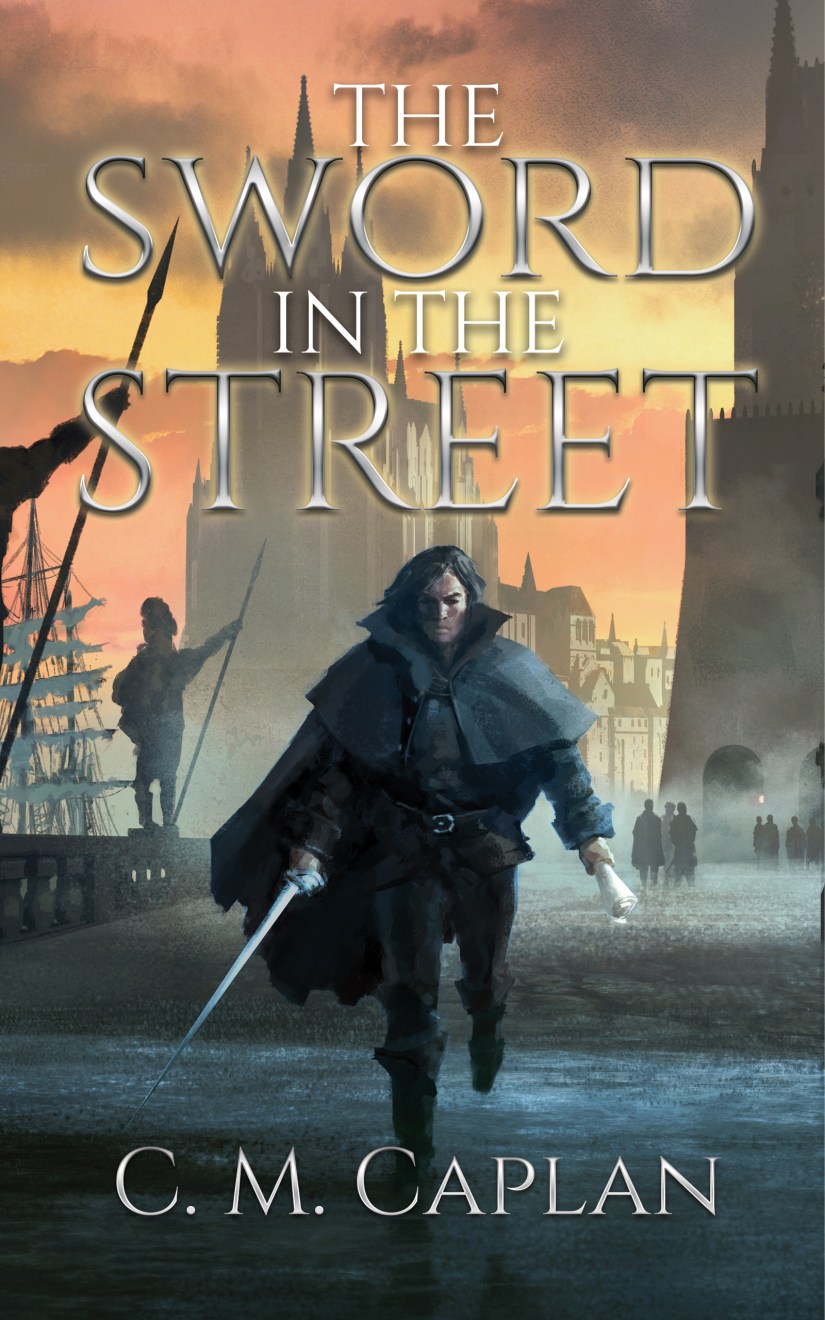
Blog Tour: The Sword in the Street – C.M. Caplan*

To learn more read this post: Launch of the tour

Trial by battle is a holy rite on Hillside. Hired blades bleed their foes in savage duels, settling everything from petty grievances to the corporate laws that keep their citizens in line. Embroiled in these cutthroat political games is John Chronicle, an impoverished swordsman with no better prospects, seeking the duel that will free him from the Dregs.

Meanwhile, John’s boyfriend Edwin, an autistic university student, befriends a fellow scholar who claims to study the arcane art of thaumaturgy. When she offers to teach Edwin this subtle magic, he hopes that he can use it to bolster John’s skill with a blade. But thaumaturgy is a dangerous magic, and the forces that drive it have other plans.

The couple soon find themselves entangled in the web of intrigue surrounding the swordsmen and their sponsors, and they’re forced to question how bloody they’re willing to get to escape poverty — and they don’t come away with the same answer.

Amazon Goodreads

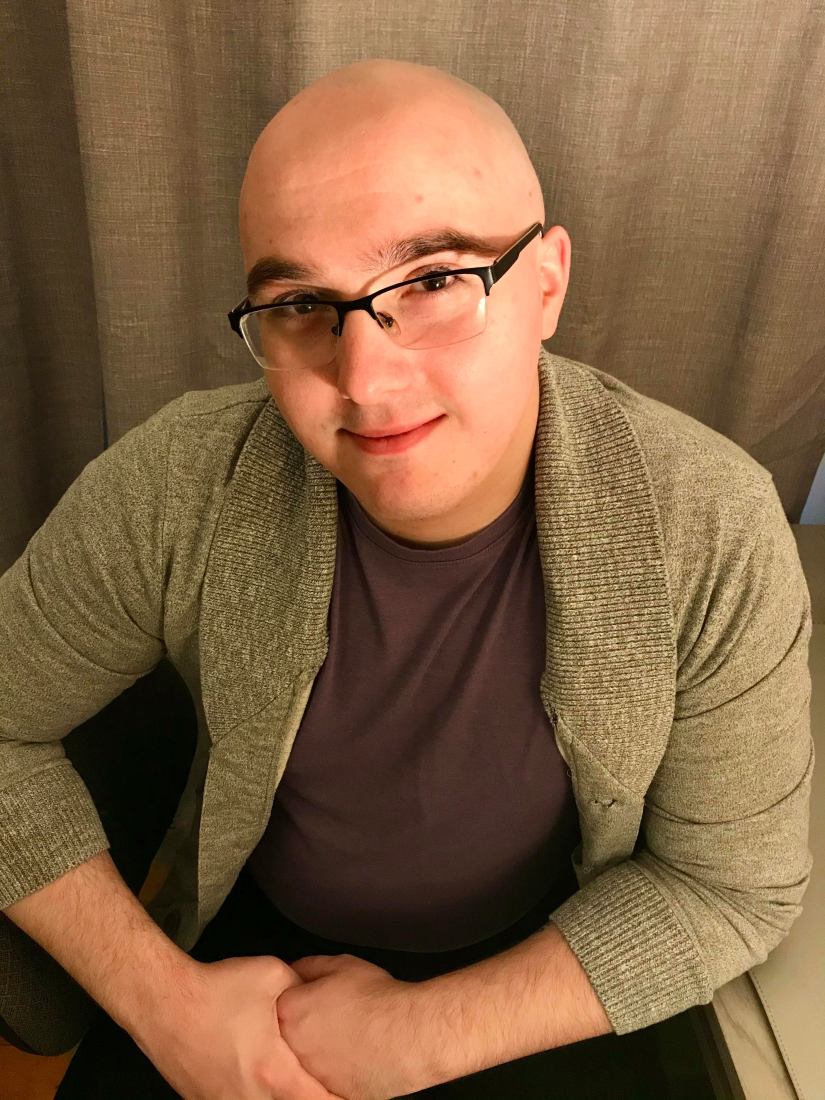
C.M. Caplan Is the author of The Sword in the Street. He’s a quadruplet (yes, really), mentally disabled, and he spent two years as the Senior Fiction Editor on a national magazine – while he was still an undergrad in college. He has a degree in creative writing from Salem State University and was the recipient of the university’s highest honor in the arts. His short fiction also won an Honorable Mention in the 2019 Writers of the Future Contest.

Caplan’s introduction to fantasy came through J. R. R. Tolkien and George R. R. Martin. He has a tattoo that roughly translates to Valar Morghulis, as written in Tolkien’s Elvish script, in an acknowledgment of that fact. Other influences include Robin Hobb, Ellen Kushner, N.K. Jemisin, Katherine Addison, John Irving, Ann Petry, K.S. Villoso, and Neil Gaiman.

He currently lives in New England, where he works remotely for a social justice theater company.

Facebook Goodreads Twitter

My thoughts:

This was a really interesting, fun read, about relationships of all forms, about struggling for financial independence, about learning to understand each others’ differences and adjusting our behaviour when we need to be easier to understand.

John is a quick tempered swordsman, his boyfriend Edwin is quieter and his autism means he finds it hard to read people – especially John. They struggle with their relationship at times – neither are great communicators.

Edwin finds his friendship with fellow student Audrey easier to understand and deal with – she’s better at expressing herself clearly.

John loses his job after losing a duel for his employer and has to make a new life for himself. He mishandles some things and upsets people who considered him a friend. But slowly, and with Edwin and Audrey’s help, he comes to realise the person he’s become isn’t who he wants to be.

He and Edwin have to decide what will make them happier – being together and being poor but decent human beings, or going their own ways and perhaps being less likeable.

I would have liked more on the thaumaturgy that Audrey is studying and that Edwin takes an interest in, but then I’m a sucker for a magic system and I can imagine that in a second book the focus might shift to their studies and investigations into magic as a way of affecting things, rather than John’s brute strength and ignorance style.

Overall this is a really strong first novel and does a nice job of world building, with the Haves living at the top of the hill and the Nots literally living in a place called the Dregs. I liked that there seemed to be more gender parity in this world – the lordess John works for is just as obnoxious as her male counterparts and holds the same power.

To follow the tour please click the poster below ⬇️

*I was kindly gifted a copy of this book in exchange for taking part in the blog tour but all opinions remain my own.