

Four hundred years ago, the Monty Python team would have been burnt at the stake for making their hit movie ‘The Life of Brian’. Luckily on its release they survived the hostile reception but the film did not, as it was banned in many countries for blasphemy. But now, years later the whole controversy will be re-ignited by the most extraordinary research that was stimulated by the film’s infamous ending, where the Pythons sing “Always look on the Bright side of Life’ while being nailed onto their crosses.
It became obvious while filming that the crucifixion process does not work. But how can that be when it is reported by every Roman historian past and present, that crucifixion was the method of capital punishment used for slaves and rebels? The simple answer not only unravelled the true story of the charismatic Jew called Jesus, but also uncovered the monumental secret that has been hinted at by esoteric groups over the centuries, the implications being nothing less than earth shattering.
THE FACTS ARE UNDENIABLE
THE EVIDENCE IS COMPELLING
BUT THE CONCLUSIONS ARE ASTONISHING

Julian Doyle is a distinguished British filmmaker with an outstanding career in the film industry. He is widely recognised for his long-standing collaboration with Monty Python, where he worked on their most celebrated films including Monty Python and the Holy Grail, Life of Brian, and The Meaning of Life. In addition to his work with Monty Python, Julian has directed several acclaimed feature films including Love Potion (1987) and Chemical Wedding (2008), a supernatural thriller co-written with Iron Maiden’s Bruce Dickinson. His directorial credits also include music videos for iconic artists such as Kate Bush’s Cloudbusting and Iron Maiden’s Can I Play with Madness.
Described by Python Terry Jones as “an original polymath”, Julian is a leading expert on Christian history and mythology. His books include The Gospel According to Monty Python, Crucifixion’s A Doddle: The Passion of Monty Python, and historical mystery thriller The Jericho Manuscript. Visit www.juliandoyle.info.
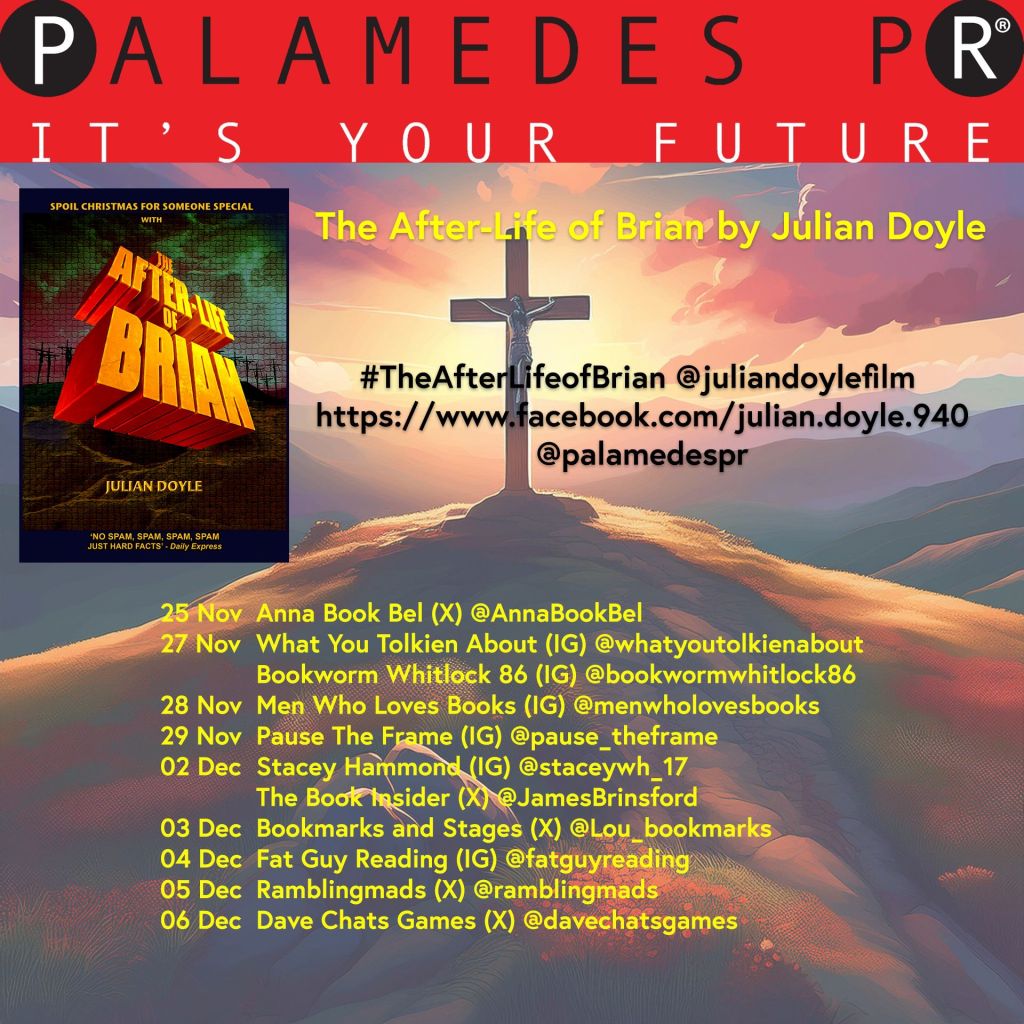
His social accounts are …
My thoughts: Two things to know before I talk about this book; 1. I love Monty Python, 2. I studied Theology at A Level and know a weird amount about Biblical history. I also managed to get a Python reference into every A Level exam essay.
Right, moving on. The author very kindly wrote me a note to explain that this book is about the historical Jesus, not the Jesus of faith. I think he was worried that with my first name (Madeleine – the French version of Magdalene, who I am named for), I might be religious.
Well, I was raised in the Church of England and went to Sunday School and church schools, which were enough to put me off. I consider myself a person of faith, or spiritual rather than strictly religious. I have a very healthy dose of scepticism and have done plenty of reading around the scriptures, so this book was perfect for me. I like to question the accepted orthodoxy, and am highly suspicious about the huge amount of editing that the Bible has gone through over the centuries.
The author starts by looking at the physical act of crucifixion, which of course is how Life of Brian ends. I found this really interesting, partly because I read a lot of crime fiction and quite a few serial killers seem to crucify their victims in fiction, but having it debunked here, makes me wonder whether any of those crime writers did any research or just assumed it would work?
I enjoyed reading the different chapters on the Gospels inaccuracies, additions, erasures, and the weird ways in which the different writers (and the later editors) adjusted the stories to fit their particular viewpoint and narrative. It’s something I’ve actually studied and I was nodding my head a lot.
There’s also a chapter on my namesake – Mary Magdalene, and whether she’s also Mary, the sister of Martha and Lazarus. He also explores the later myths and beliefs about her, and the Templars fascination with her.
What she definitely isn’t is a prostitute. That comes from a misreading of John’s Gospel, where a story about an unnamed sex worker is after a story about Mary M. They are not the same woman. That’s just some lazy casual sexism and misogyny. From the church? NEVER!! This was really interesting reading too, having read a book about Jesus’ women. I won’t give you an essay here, you can read them yourself.
There’s an incredible amount of research been done here, and it is all extremely interesting. I won’t break it all down. I did get a bit confused by all the Templar Knights, Masons, references to that godawful Dan Brown rubbish (bad literature, no grasp of geography, terribly poorly researched) as though it was legitimate scholarship, I am aware there are hundreds of theories and conspiracies about these organisations, I dont know much about any of it and thought it dragged some of the very good, legitimate points being made, down.
Overall I thought this was a really interesting book that makes some interesting points and it’s very readable, which not all scholarly examinations of the Bible are, trust me. I would have liked more on making Brian, but that was the jumping off point to looking more closely at the historical records in contrast to the Bible’s versions of events. I don’t know that I’d give this book to my religious relatives, but I can think of several people I know who would really enjoy it and happily hold internal debates with it as I have.
*I was kindly gifted a copy of this book in exchange for taking part in this blog tour, but all opinions remain my own.






 ramblingmads