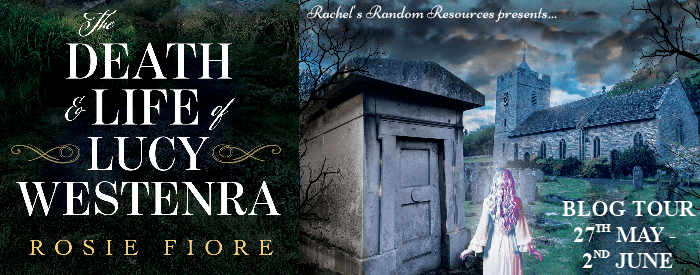
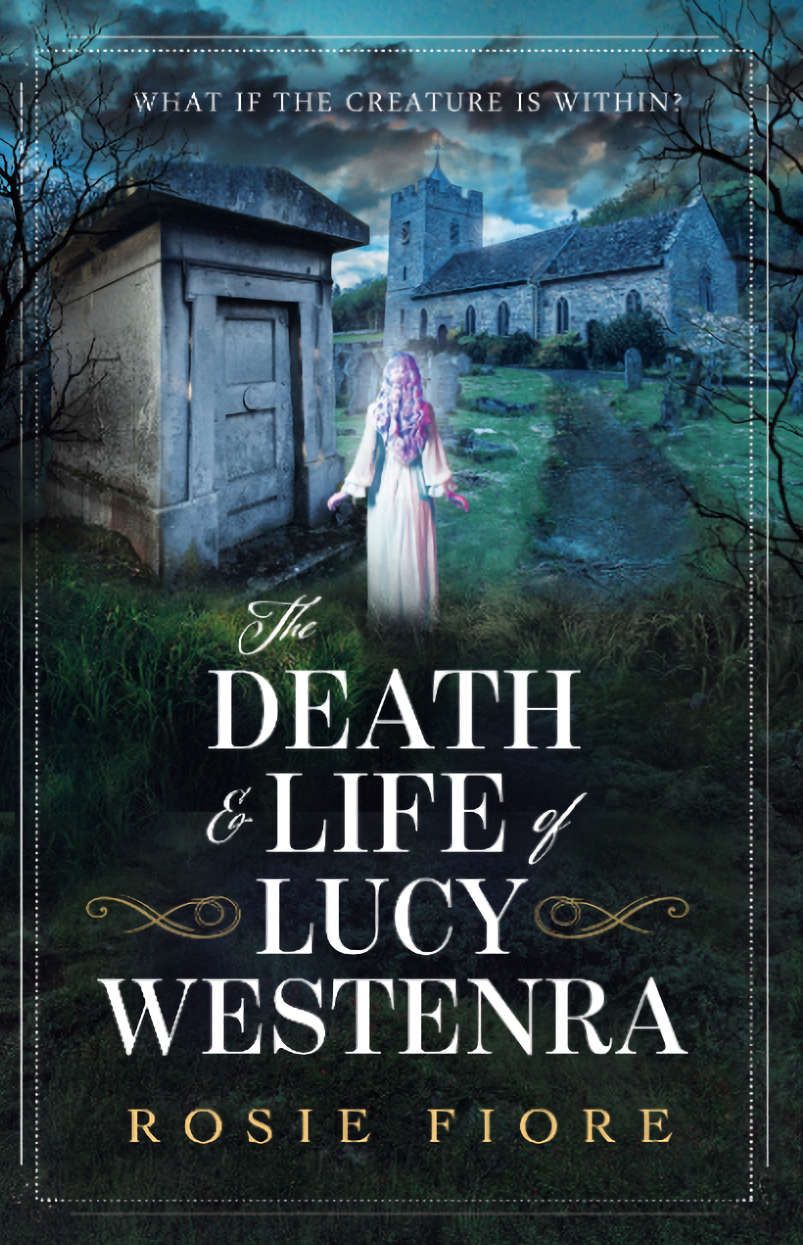
What desperate steps will Lucy Westenra take to save her own life?
Hillingham in Hampstead, once the home of the well-to-do Westenra family, is now divided into apartments. When teacher Kate Balcombe sets about renovating her flat in the attic, she finds an unsent letter written 130 years before by Lucy, the nineteen-year-old daughter of the house.
You may know Lucy from Bram Stoker’s Dracula… a pretty, flirtatious girl with three ardent suitors, she is Mina Harker’s best friend. When Lucy falls mysteriously ill and dies, Van Helsing identifies her as a victim of the vampire. But what if the monsters who hunt Lucy are much closer to home?
As Kate begins to investigate Lucy’s story, she meets James Harker, Mina’s great-great grandson, and together they uncover a long-hidden story of deception and murder.
Rosie Fiore is the author of eight published novels, including Wonder Women, After Isabella and What She Left, as well as The After Wife, written as Cass Hunter. She is a teacher of creative writing and a Royal Literary Fund Fellow. She lives in North London with her family, and can frequently be found wandering on the Heath or haunting a churchyard.
My thoughts: I really liked this book, it gives life and agency to Lucy and Mina, the victims of the count in Bram Stoker’s book. Two young women who don’t have much say or power. Which is of course true of many women in the Victorian era, there might have been a woman on the throne, but women were still not free or equal.
Kate finds Lucy’s letter in her mum’s old flat, never delivered, and wonders about the woman who wrote it, her life, and what happened to her. As she investigates, events will change her life forever. She will also get a glimpse of who her mum was, having lost her quite young.
Along the way she meets James Harker, Mina’s great-great-grandson, and a bond forms. The two will follow in Lucy’s footsteps, from Hampstead to Devon and finally all the way to Texas.
Lucy’s story is tragic, mostly because she has so little power over the events of her life, she cannot fight back against the men who want to use her, so she must find a different path and set herself free.
Clever, interesting and enjoyable, bringing old characters into a new and more rounded version of the story we know from Dracula.
*I was kindly gifted a copy of this book in exchange for taking part in this blog tour, but all opinions remain my own.
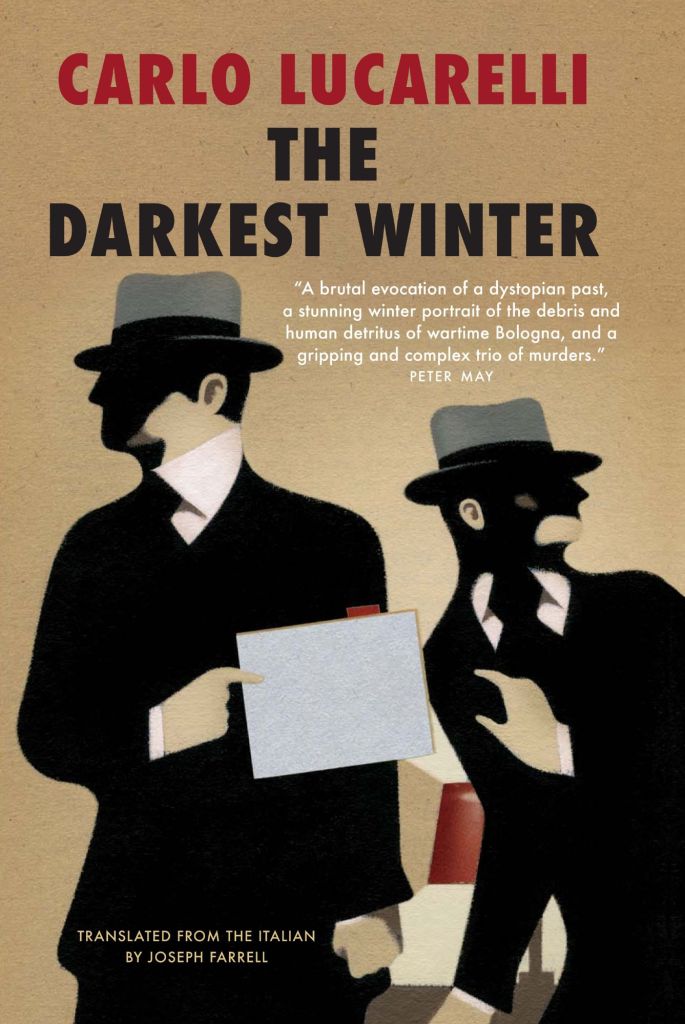
In November 1944, in the worst winter ever known in Bologna, less than a year since the founding of the Republic of Salò, the bomb-scarred streets are filled with starving refugees who have fled the advancing Allies. The Fascist Black Brigades, the officers of the S.S. and the partisans of the Italian Resistance compete for control in bloody warfare.
Comandante De Luca, once “the most brilliant investigative officer in Bologna” and now working for the Political Police in a building that doubles as a torture facility, finds himself in over his head when three murders land on his desk: a professor shot through the eye, an engineer beaten to death, and a German corporal left to be gnawed on by rats in a flooded cellar.
Losing sleep and his peace of mind, De Luca must close all three cases with ten lives on the line: the Italian hostages who will face a Nazi firing squad if the corporal’s killing is not solved to their satisfaction. As he threads his way through a web of personal and political motivations, risking his life with every step, De Luca will uncover to his own cost the secrets awaiting him in the frozen heart of Bologna.
Carlo Lucarelli was born in Parma in 1960. While researching for his thesis on the history of Italian law enforcement, he became intrigued by the Italian police force’s role in the political upheavals of the 1940s during and after the Second World War. From this seed sprouted his De Luca trilogy, later to grow into an oeuvre of more than twenty crime novels focusing on various characters. Lucarelli hosted the popular late-night Italian television programme Blu notte misteri d’Italia, on unsolved crimes and mysteries, and he is the founder of the Italian crime-writing collective Gruppo 13. He is also a journalist and has worked for multiple Italian newspapers.
My thoughts: I found this very interesting, I don’t know much about Italy in WW2 apart from the fact that they eventually gave the fascists the boot and joined the Allies, so learning a bit about the history and specifically about Bologna, which had its own complicated situation in the 40s, was good.
I also liked De Luca, he doesn’t exactly relish certain aspects of his job at the political police, he doesn’t participate in torture and would probably prefer to just stay a detective, solving murders, much as he does here. He’s trying to solve several different crimes at once, one written off as a crime of passion, another of a rat chewed German soldier found in the water, a third of a man supposedly with connections to the partisans waging their own war on the occupying force.
There’s wheels within wheels, a spy in the department, a woman who may or may not be a killer, the lives of ten prisoners on the line, lies, half truths and the ever present threat of being arrested himself, just because.
He forms an odd sort of partnership with another officer from the passport office, who might be a member of the resistance, as well as a German lieutenant who wants to find out what the dead soldier did with a load of stolen goods, themselves taken from the people of the city.
There are refugees everywhere, living in strange places amongst the bombed out buildings, a whole community sheltering in a theatre, based on what really happened at the time.
The research that has gone into this book is fascinating, it really brings the past vividly to life, I could picture the streets and the soldiers, the air of menace and fear, the scurrying people trying to avoid notice.
De Luca is a brilliant detective, he slowly builds his cases, contending all the while with the complex and delicate political situation, with the genuine risks to his own life if someone isn’t happy with his answers.
If you like historic crime fiction, or any combination of those genres, this is definitely worth reading.
*I was kindly gifted a copy of this book in exchange for taking part in this blog tour, but all opinions remain my own.
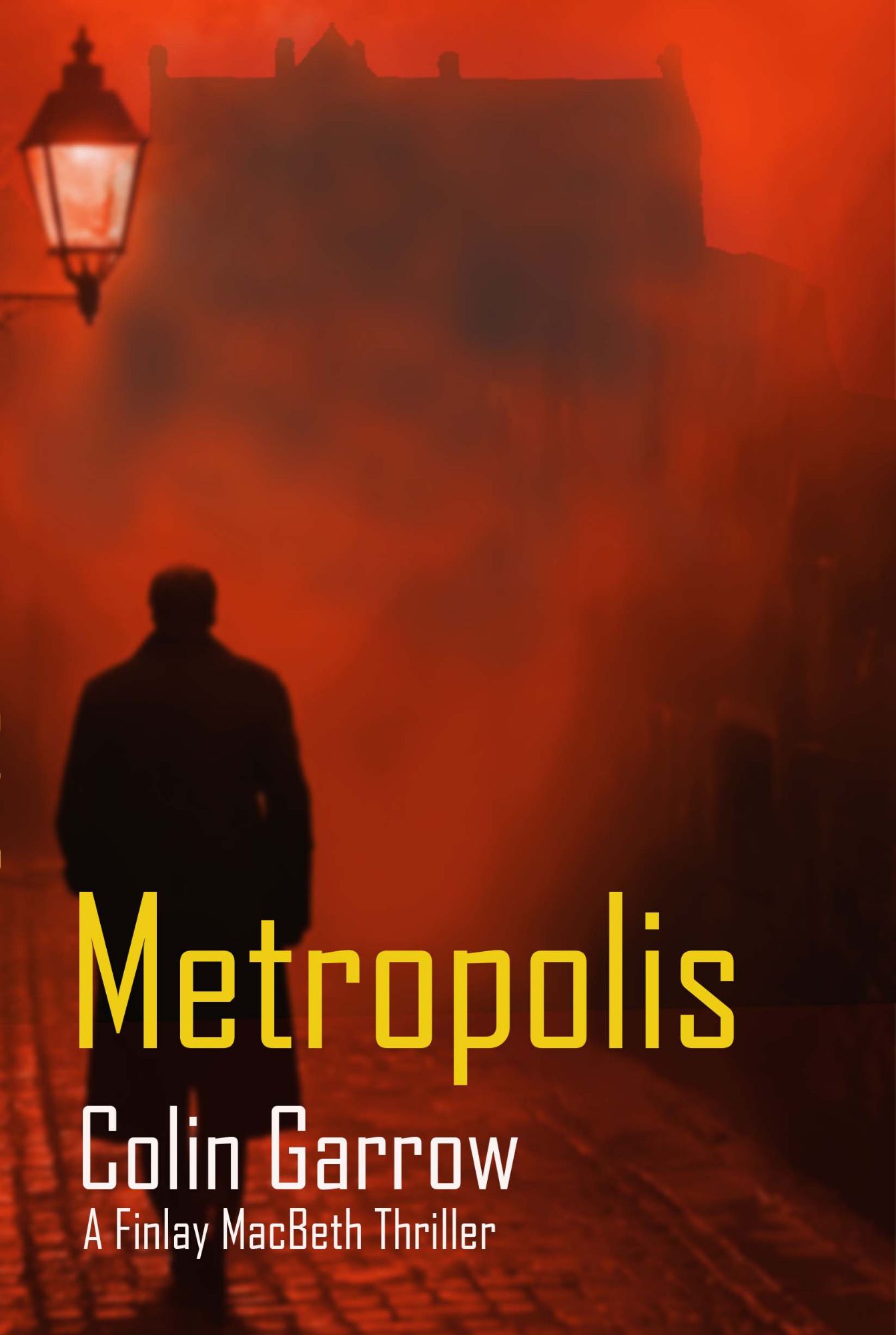
Edinburgh, 1936. People are disappearing. The police are clueless. Can Finlay MacBeth track down the perpetrator before someone else goes missing?
Haunted by his recent past, Professor Finlay MacBeth returns to his home town to take up a new post at the university. Within hours, his reputation for solving the occasional murder prompts the police to ask for his help. Four men—seemingly unconnected—have vanished into thin air. MacBeth must find whatever it is that links the men before the kidnapper strikes again.
But the police aren’t the only ones interested in MacBeth’s activities, and the amateur sleuth soon discovers that finding the missing men is the least of his problems…
In this thriller series set in Edinburgh, Metropolis is book #1 in the Finlay MacBeth Thriller series.
Colin Garrow grew up in a former mining town in Northumberland. He has worked in a plethora of professions including taxi driver, antiques dealer, drama facilitator, theatre director and fish processor, and has occasionally masqueraded as a pirate.
He has published more than thirty books, and his short stories have appeared in several literary mags, most recently in Witcraft, and Flash Fiction North. Colin lives in a humble cottage in Northeast Scotland where he writes novels, stories, poems and the occasional song. He also plays several musical instruments and makes rather nice vegan cakes.
My thoughts: Finlay MacBeth returns to his home city of Edinburgh to teach literature at the university, but news of his success in helping the London police has reached there before him, and after a series of disappearances, the police ask him for his help. Aided by his young apprentice and his flirty landlady, he soon gets to work puzzling out the connections and the perpetrator.
However he is being followed by a mysterious man in a trench coat. MacBeth has secrets, secrets he must protect, but someone out there knows them. And now he will need to find out who.
Clever, atmospheric, full of literary references, particularly Sherlock Holmes, and with an interesting cast of characters as well as an intriguing and somewhat disturbing plot. I look forward to the next book.
*I was kindly gifted a copy of this book in exchange for taking part in this blog tour, but all opinions remain my own.
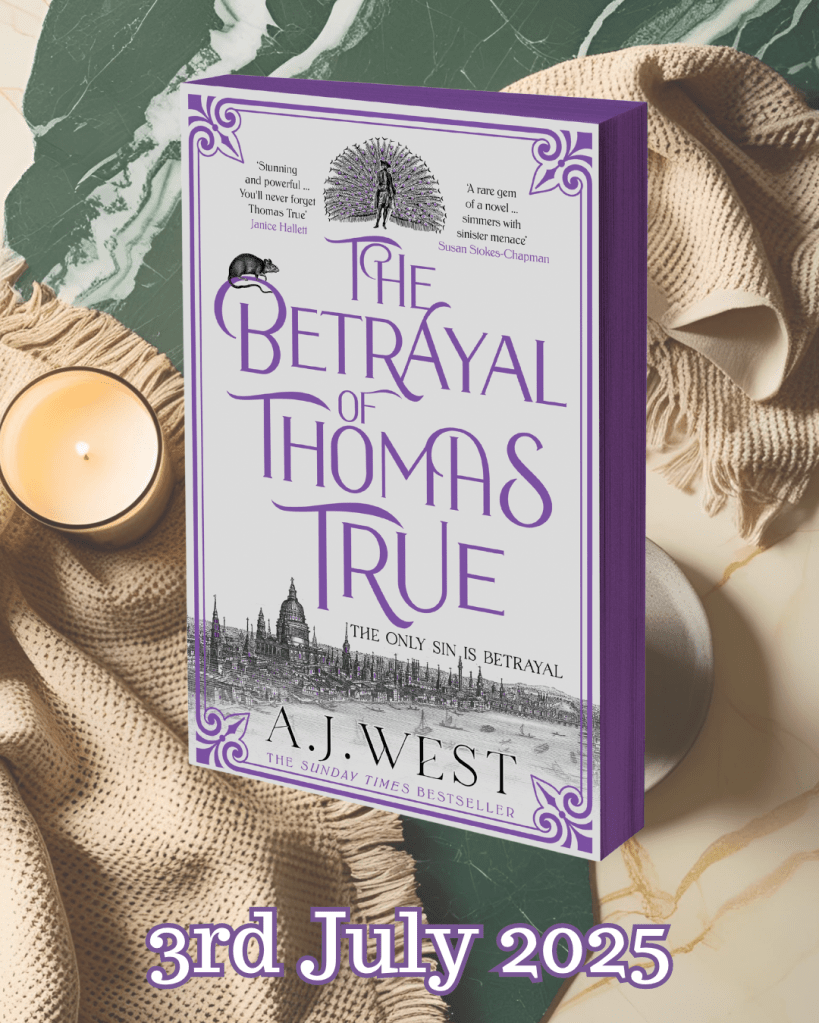
You may remember I reviewed the hardback version of this book a while ago, and now I am sharing the gorgeous paperback cover. Look at it! Isn’t it gorgeous. Order a copy at the link below.
The only sin is betrayal…
It is the year 1715, and Thomas True has arrived on old London Bridge with a dangerous secret. One night, lost amongst the squalor of London’s hidden back streets, he finds himself drawn into the outrageous underworld of the molly houses. Meanwhile, carpenter Gabriel Griffin struggles to hide his double life as Lotty, the molly’s stoic guard. When a young man is found murdered, he realises there is a rat amongst them, betraying their secrets to a pair of murderous Justices. Can Gabriel unmask the traitor before they hang? Can he save hapless Thomas from peril, and their own forbidden love? Set amidst the buried streets of Georgian London, The Betrayal of Thomas True is a brutal and devastating thriller, where love must overcome evil, and the only true sin is betrayal…
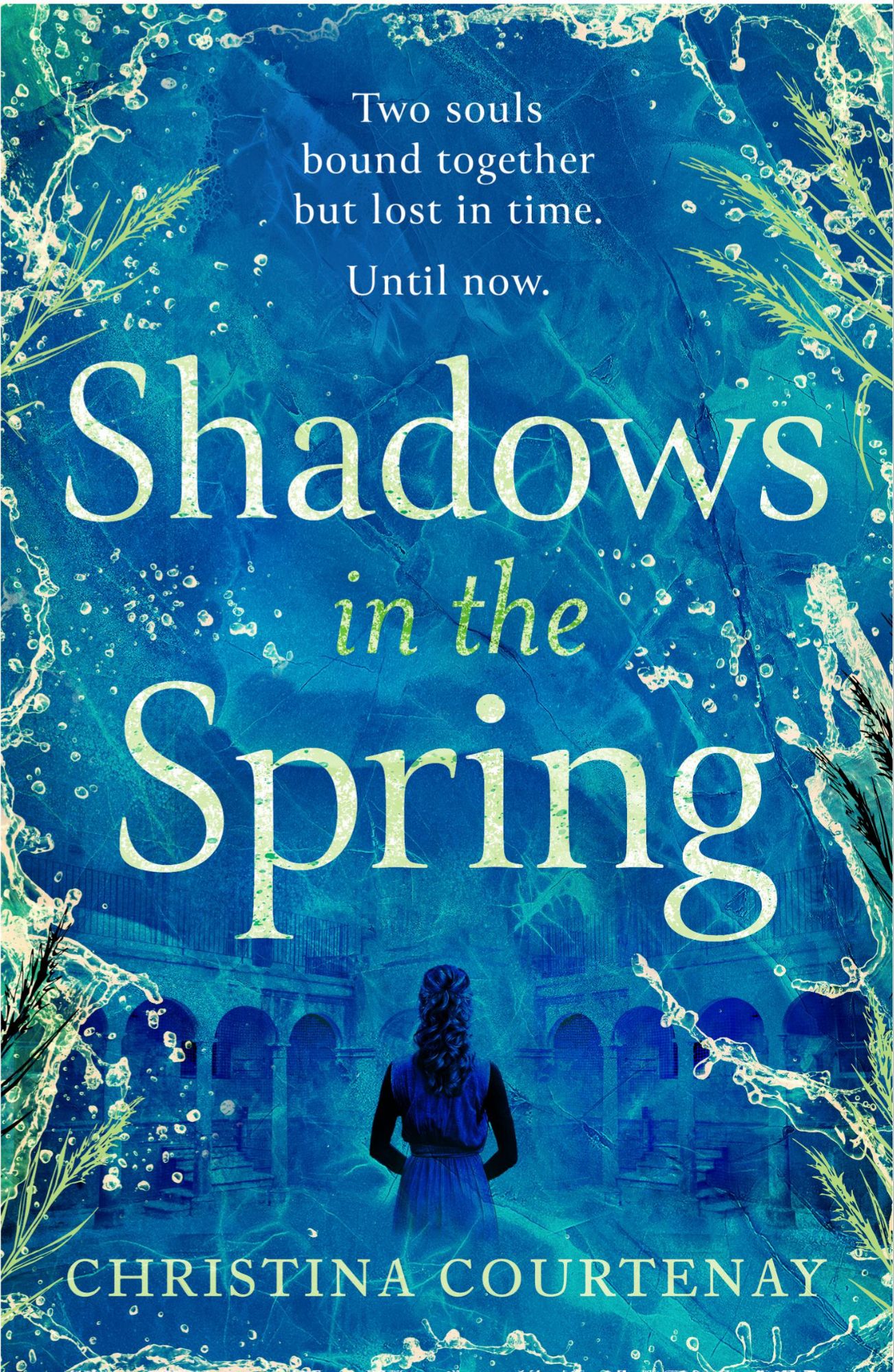
Two souls bound together but lost in time. Until now.
AD 80 Duro of the Iceni tribe escaped life as an enslaved gladiator and is now finally home in Britannia with one thing on his mind: vengeance. For 20 years he has sought the Roman legionary who destroyed his family. What he didn’t expect was Gisel: a fierce Germanic woman with long white-blonde hair, forced into slavery by the Romans. Hypnotised by her spirit and her beauty, Duro frees Gisel and slowly tries to win her trust as they work together to complete his quest.
Present Day Mackenna Jackson returns to Bath with a broken heart, thanks to rockstar Blue Daniels. Luckily she can still count on Blue’s former bandmate Jonah Miller as a listening ear. But Jonah has secretly been fighting stronger feelings, drawn to Mac’s quiet confidence and gorgeous white-blonde hair. As they explore the area, memories they can’t quite explain flood them both. Is the spark between Mac and Jonah in fact a sign of something much deeper – a love enduring through millennia – or can it all be an illusion?
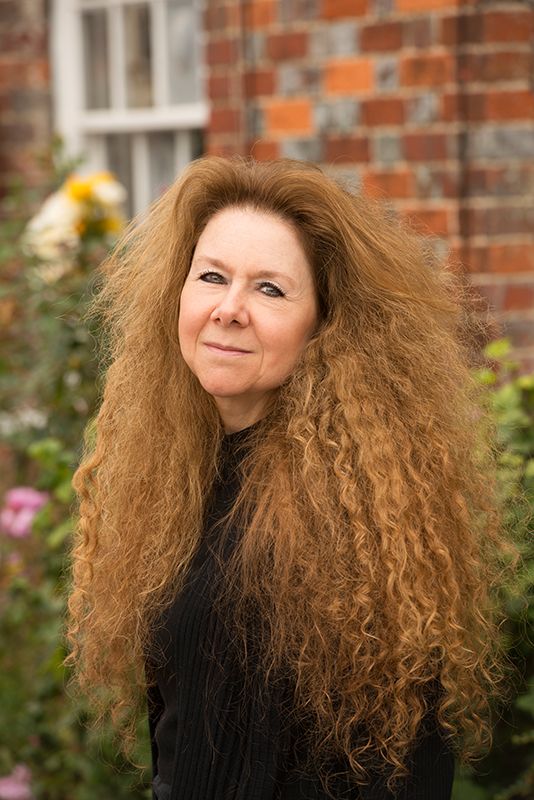
Christina Courtenay writes historical romance, time slip/dual time and time travel stories, and lives in Herefordshire (near the Welsh border) in the UK. Although born in England, she has a Swedish mother and was brought up in Sweden – hence her abiding interest in the Vikings.
Christina is a Vice President and former Chair and of the UK’s Romantic Novelists’ Association and has won several awards, including the RoNA for Best Historical Romantic Novel twice with Highland Storms (2012) and The Gilded Fan (2014) and the RNA Fantasy Romantic Novel of the year 2021 with Echoes of the Runes.
SHADOWS IN THE SPRING (dual time historical romance published by Headline Review 24th April 2025) is her latest novel. Christina is a keen amateur genealogist and loves history and archaeology (the armchair variety).
My thoughts: By now, you should know that I’m a fan of Christina Courtenay and her time travelling romances, a history loving nerd and as someone who grew up visiting the Roman ruins of Veralanium (St Albans) this is right up my street. The Iceni are probably the most famous tribe of ancient Britons (Boudicca was their queen at one point and her statue stands on Westminster Bridge) in Roman occupied Britain.
Duro has escaped a life as a slave and gladiator in the Roman Empire, thanks to a handy volcanic eruption (Pompeii) and returned to his home in search of his family. When he was taken his mother was brutally murdered and his sister also taken as a slave by a particularly unpleasant Roman soldier. He has long vowed revenge. And after reconnecting with his brother, he sets out to find his mother’s killer.
Along the way he saves a young Germanic woman from a life of slavery and rape, offering her the opportunity to join him in his journey and be free. Gisel is hesitant at first, but as they travel she sees he is genuinely a good man and they begin to fall for one another.
In the present McKenna too is finding a genuine person in her spoilt ex’s former bandmate Jonah. The two become friends after she moves into her aunt’s former home in Bath, while he lives not far away. They’re both interested in the Roman history in the area and after Jonah’s dog digs up a dead Roman in the garden, start looking into area’s past more closely. They too start to bond and fall for one another. But strange echoes from the past suggest this isn’t the first time they’ve known one another….
Both stories are really enjoyable to follow, although I did enjoy Duro’s travels more than anything else as I recognised a lot of the Roman place names from other things I’ve learnt and being from London, itself a Roman settlement.
Although no one actually time travelled in this book, it was still really enjoyable and I loved all the little things that happened in one storyline and then popped up in the other (like the dead man in Jonah’s garden, and the ring Mac wears).
*I was kindly gifted a copy of this book in exchange for taking part in this blog tour, but all opinions remain my own.
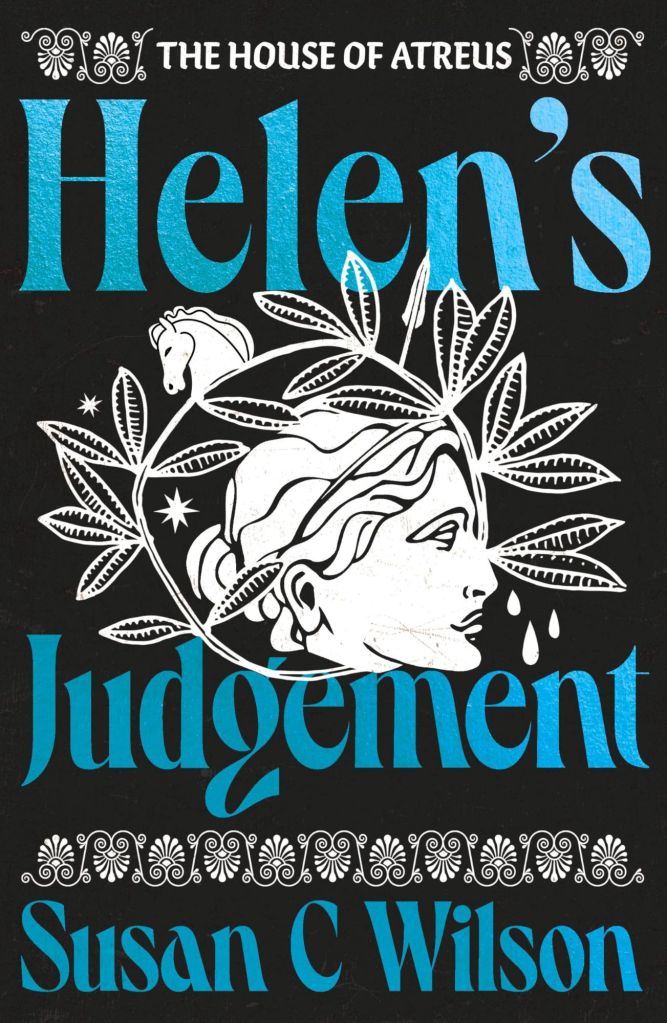
She’s the most scapegoated heroine in Greek mythology, but there’s never just one side to any story. This new framing uncovers the complexities of Helen of Troy–a woman tormented by the blame placed on her by others, and tortured by her own guilt.
“We all blamed Helen”
Haunted by her decision to leave her child behind in fleeing her unhappy marriage, Helen seeks to build a new life in Troy with her lover, Paris. She yearns to recreate the childhood family she lost when she married Menelaus, but her outraged husband vows to regain her by force, at the head of a vast army.
Facing hostility from all sides, Helen must decide where her loyalty–and her safety–lies.
Perfect for fans of Greek mythology retellings, and Madeline Miller’s Circe, Jennifer Saint’s Elektra, and Pat Barker’s The Women of Troy.
My thoughts: Helen of Troy might be one of the most hated women in literature, the face that launched a thousand ships, the woman who cuckolded her husband, ran away with a prince and brought about the destruction of the legendary (and real) city of Troy.
Narrated by the ghost of Achilles, this is Helen’s story.
When Agamemnon and Menelaus arrive at her childhood home, Agamemnon has already murdered her brother-in-law and nephew and forced her sister Clytemnestra to marry him, so she isn’t too favourable. His brother doesn’t appeal, he’s not the handsome prince of her imagination, but her father has little choice, Agamemnon threatens to seize their kingdom too.
Not the most auspicious start to a marriage, but not an entirely unexpected one considering the time. When Helen runs off with Paris to Troy, abandoning her daughter, and leaving her homeland behind, she hardly expects what happens next. King Priam refuses to send her back and the Greeks famously come together to lay siege to Troy for ten long years.
Achilles also tells us about the goings on inside the Greek encampment. Agamemnon rarely leaves his tent, preferring to let the others fight, like generals ever since, which annoys Achilles. Then comes the infamous falling out that results in the death of Achilles’ cousin and closest friend Patroclus, Achilles’ revenge killing of Hector and finally Paris’ cowardly killing of Achilles. Finally the horse makes an appearance.
Some of the most famous events of the Trojan war. I always wondered why Shakespeare never staged this – it feels very in keeping with some of his tragedies.
Obviously Homer (whoever he or they were) got there first, but Susan C. Wilson retells this most famous of stories from new perspectives – Achilles and Helen. Had Helen’s father held out and she married Achilles, none of this would ever have happened, nor any of the resulting events.
Helen’s account of the destruction of Troy is shocking, graphic and you can imagine people’s genuine horror as the Greek soldiers lay waste, killing the men and taking the women to be slaves. King Priam’s death is awful, the proud man reduced to blood and bones in moments.
But Helen’s end is equally gruesome, she won’t be returning with Menelaus, she will never see her daughter again. The Greeks have spent ten long years waiting for this moment. The judgement of Helen.
The title can be seen in different ways – Helen’s own poor judgement in running off with the vapid but pretty Paris, the judgement of the Trojans on her, and that final judgement after the long years of fighting. A fight that doesn’t really have much to do with her, one that feels like an excuse as the Greeks also want access to the Hellespont, and to establish themselves in Asia, beyond the walls of Troy and its allies.
This was a really interesting retelling of this most famous story, one I’ve studied in depth before and often enjoyed, but that gives agency back to Helen, and furthers the story of the House of Atreus from Clytemnestra’s Bind, the first book in this series.
*I was kindly gifted a copy of this book in exchange for taking part in this blog tour, but all opinions remain my own.
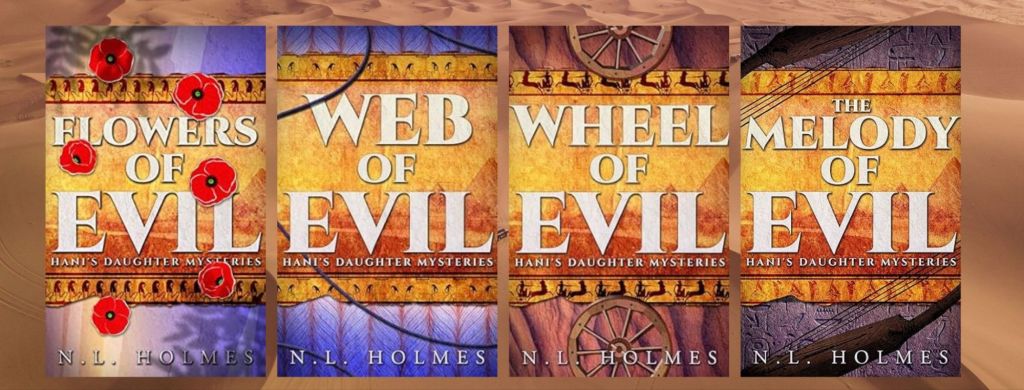
Step into the sandals of Neferet and Bener-ib — two women doctors in ancient Egypt who never expected murder to become part of their medical routine. With the help of their perceptive teenage apprentice and Neferet’s steadfast father, this unlikely investigative team takes on crimes that shake their community to the core.
Across four rich, standalone books — Flowers of Evil, Web of Evil, Wheel of Evil, and The Melody of Evil — N.L. Holmes brings ancient Thebes to life through everyday lives touched by extraordinary events. There are no pyramids here — just humanity, heart, and a whole lot of suspense.
One of the things about ancient Egyptian society that inspired the character of Neferet is the status of their women. They were freer and more respected than in almost any other contemporary society, even though we’d have to admit that that society, like our own, was basically patriarchal. Apart from being honored as mothers, lovers, and helpmeets, women were legal majors, able to own property, testify in court, bring lawsuits, and conduct business under the same legal protections as men. They could sit on village councils, and we even have records of women who served as the mayor of their village. Although it was definitely the exception, they could rule the entire country in the person of a queen,.and these were very hands-on monarchs with few limits to their authority. In the Old Kingdom, Egypt’s formative period, at least one woman served as vizier or prime minister, and there were classes of priestesses that corresponded to almost every class of priest. Unfortunately, these opportunities for religious authority were restricted in later periods to women of the royal family.
The idea of a female vizier or priest raises the issue of whether women were literate. Only 1% of the population could read and write, and literacy was the key to social status. We have no positive testimony that this golden skill was confided to any but males. However… it’s hard to imagine a vizier who couldn’t read the reports that were brought to her. It’s difficult to conceive how the female stewards of large royal or private estates could supervise the running of palaces without being at least basically lettered. The same is true of female physicians—who did exist— since Egyptian medicine rested upon casebooks based on generations of trial and error. Thus, I think the case of our Neferet, whose menfolk are all literate scribes, isn’t improbable. There must have been women now and again who were trained by their fathers or brothers, even if they didn’t formally attend the scribal school conducted at the temple of Amen-Ra, the House of Life.
That’s why Neferet became the character she is: headstrong, pushy, and unconventional. She does a lot of things that wouldn’t have been common in her day but wouldn’t have been forbidden either. She was lucky enough to live in an age when women were strong and sometimes independent, visible, and fully able to contribute to their society in a variety of ways. She would have had those all-important role models. Some men might have disapproved of her, but others would have accepted her forwardness. And I think the great and proactive goddesses of Egypt’s pantheon would have looked on with affection.
Excerpt
“Can you do anything?” the woman cried tremulously, clutching at Neferet’s arm.
But Neferet could think of nothing encouraging to say. Her insides had that hollow, leaden feeling that meant the worst was about to happen.
“There’s no point in stitching up the outside,” she said gently. “He’s lost a lot of blood, and they’ve chopped him up pretty seriously inside. As the medical books say, ‘This is not a case I will treat.’”
The woman understood and began to whimper. She reached out a hand to touch her husband’s shoulder but then drew back as if she’d just discovered it was someone else. A gloomy silence fell over the group, broken only by the increasingly weak huff of the patient’s breath. His lips moved feebly, and Bener-ib leaned over his face.
“I think you’d better stand with him, mistress,” Neferet said. “His soul is ready to fly. He might have something to say to you.”
The woman drew closer fearfully. “Sen-em-iah, my brother, I’m here.”
At first, Neferet wondered if she’d misunderstood and the woman was really his sister—although from her age she might have been his daughter—but brother and sister were terms of endearment often used by married people. Everyone stood, hushed, waiting for a final word from the threshold of the other world. Sen-em-iah said nothing. His head lolled finally, and a tiny sibilance of breath escaped him.
They all stared at him expectantly until Neferet said in a quiet tone, “I think he’s passed to the West, mistress.”
She took the patient’s hand and pressed her fingers against the inside of the wrist. No pulse.
The woman stared at Neferet as if she couldn’t believe her. She made no move to wail or tear her hair.
“Who is he? Why might someone have done this?”
Since the wife was frozen, one of the servants answered. “Sen-em-iah son of Nakht is—was—Bearer of Divine Offerings of Amen, mistress. Chief florist of the Hidden One’s temple, like his father before him.”
Yahyah. That explains why he was just coming home at this hour of the morning. Florists work all night, while it’s cooler.
“Who would want to kill a florist?” she asked. “They don’t hurt anybody.”
“Maybe it was just a random attack,” suggested another of the servants. “Maybe they were going to rob the master.”
“Were you all with him when he was attacked?”
“Not me,” said an older man. “I’m the steward. I came out with the mistress of the house when the others yelled. These young fellows are the litter bearers and bodyguards. Yes, they were with him.”
No casual robber would have attacked anybody protected by eight stalwart young men. And Neferet knew what the servants didn’t—the attacker had not just stabbed Sen-em-iah but had ripped viciously. He had aimed to kill.
The steward said, “We brought him all the way here because we didn’t know where else a sunu could be found at this hour of the morning. One of these fellows lives in this neighborhood.”
Bener-ib, who had been listening intently, leaned over Sen-em-iah and drew down his eyelids.
That gesture brought his wife out of her shock, and she began to cry, quietly at first, but soon she was howling, keening, raking at her face with her nails.
“Perhaps mistress would like to go home, notify the children?” suggested the steward, taking her by the elbow. “If we could leave the master here briefly until we can call the servants of Inpu…?” He raised inquiring eyes to the two sunets, one after the other. Already, he was edging the distraught widow toward the door. The block of servants crowded after them.
“Of course,” said Neferet. “Is it all right if we come by later to ask a few questions? We’ll have to report this murder, now that we’re involved, and we’ll need to explain what we see’s been done to the body.”
The steward nodded distractedly over his shoulder, and the entire crowd disappeared through the door. The woman’s wails trailed off as they exited the gate, and soon Neferet, Bener-ib, and Mut-tuy were left staring at one another in silence. The young girl’s eyes were round as plates and scalpel sharp.
Mangler had entered and was lapping blood from the smooth plaster floor, his tail wagging in pleasure at the windfall.
Neferet gave her partner a long significant stare. “Do you realize what this is? Our first murder case.”
“Our first? Will there be more?” Bener-ib said faintly.
“Look at that wound. Somebody wanted to be sure this florist died. Somebody who knew what they were doing. A soldier, maybe. A professional assassin.” Neferet turned to the body of Sen-em-iah, whose eyes had popped open a slit. He seemed to be watching them. “If only he could tell us who did this. I feel sure he knew. But he didn’t have any final words.”
“Oh yes, he did,” said Bener-ib, brightening. “I distinctly heard him say something just before you called his wife over.”
Neferet’s heart stepped up its pace. She seized Bener-ib’s hand. “He did? Quick, Ibet! What did he say? This could be the clue to his murder!”
Bener-ib looked around as if searching for witnesses to support her, then she pronounced firmly in her girlish voice, “He said… he said, ‘Sekhat. Rabbit.’”
My thoughts: This series is so good, if you love crime fiction, historical fiction, strong female protagonists, loving families, adventure, cute animal sidekicks, it’s all here.
Hani is an important scribe working in the Egyptian empire for the boy king we know as Tutankhamen. His daughter, Neferet is a sunet or doctor, who along with her partner Bener-if (in life and medicine) provides medical treatment to the people and occasionally animals in their community. She has adopted a family of orphans, and is meant to be training one as her apprentice, only Mut-tay would rather be a detective.
When a man dies in their dispensary, Neferet takes it upon herself to investigate his murder and the series has her and her friends, as well as members of her family, look into suspicious deaths of various people from the community. Mostly people who would be overlooked as not important, like a florist, a musician, a scribe. The medjay (the police) are lazy and corrupt so if Neferet and Hani don’t look into things, no one else will and the dead will never get justice.
The books are really enjoyable and relatable, despite being set thousands of years in the past. The characters and their relationships are fully realised and I really rooted for them, to get justice and to be safe as they often come up against really nasty people. Luckily their canine bodyguard, Brute, is there to save them. There is a fifth book due later this year and I can’t wait!
*I was kindly gifted a copy of this book in exchange for taking part in this blog tour, but all opinions remain my own.
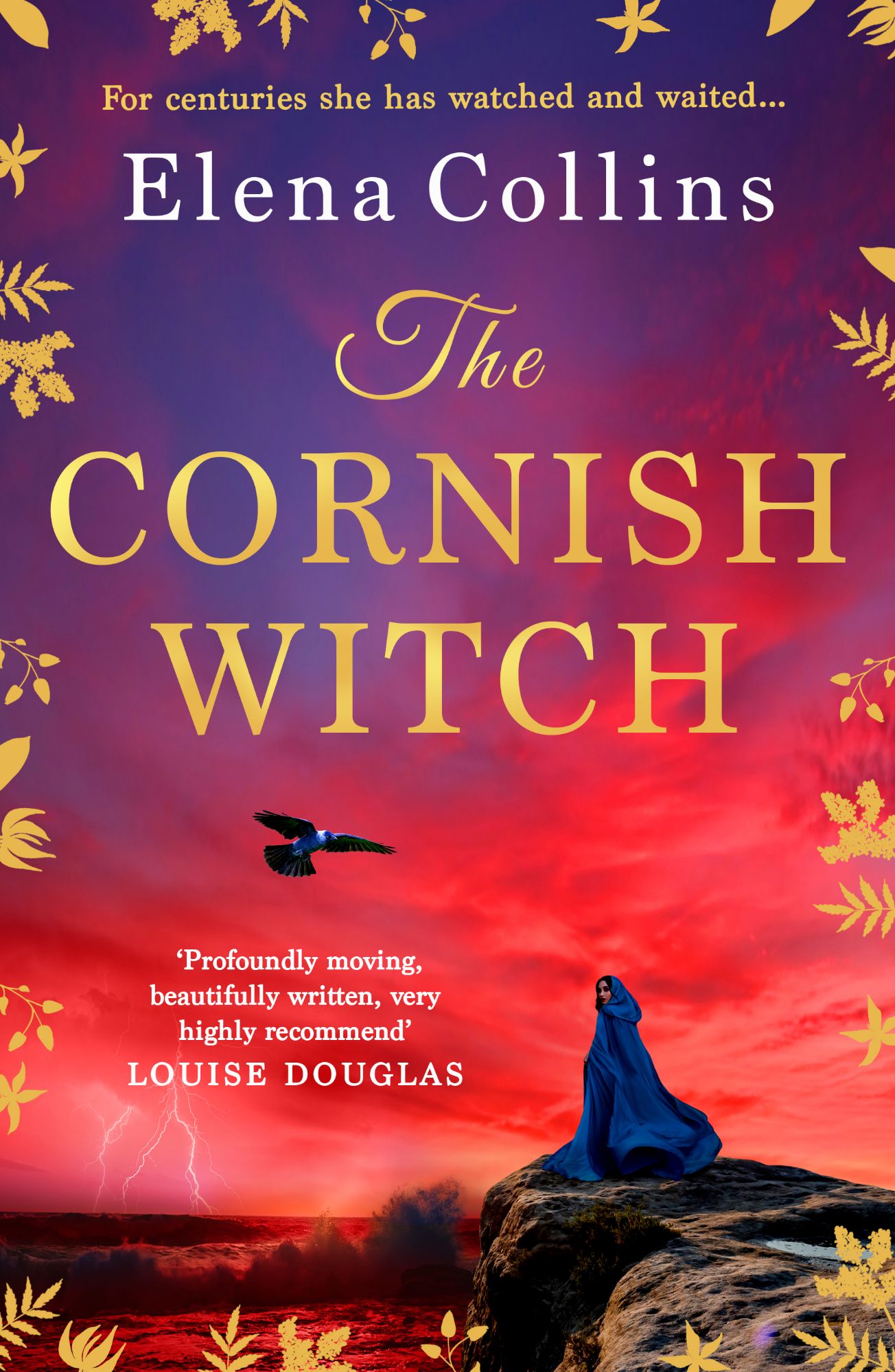
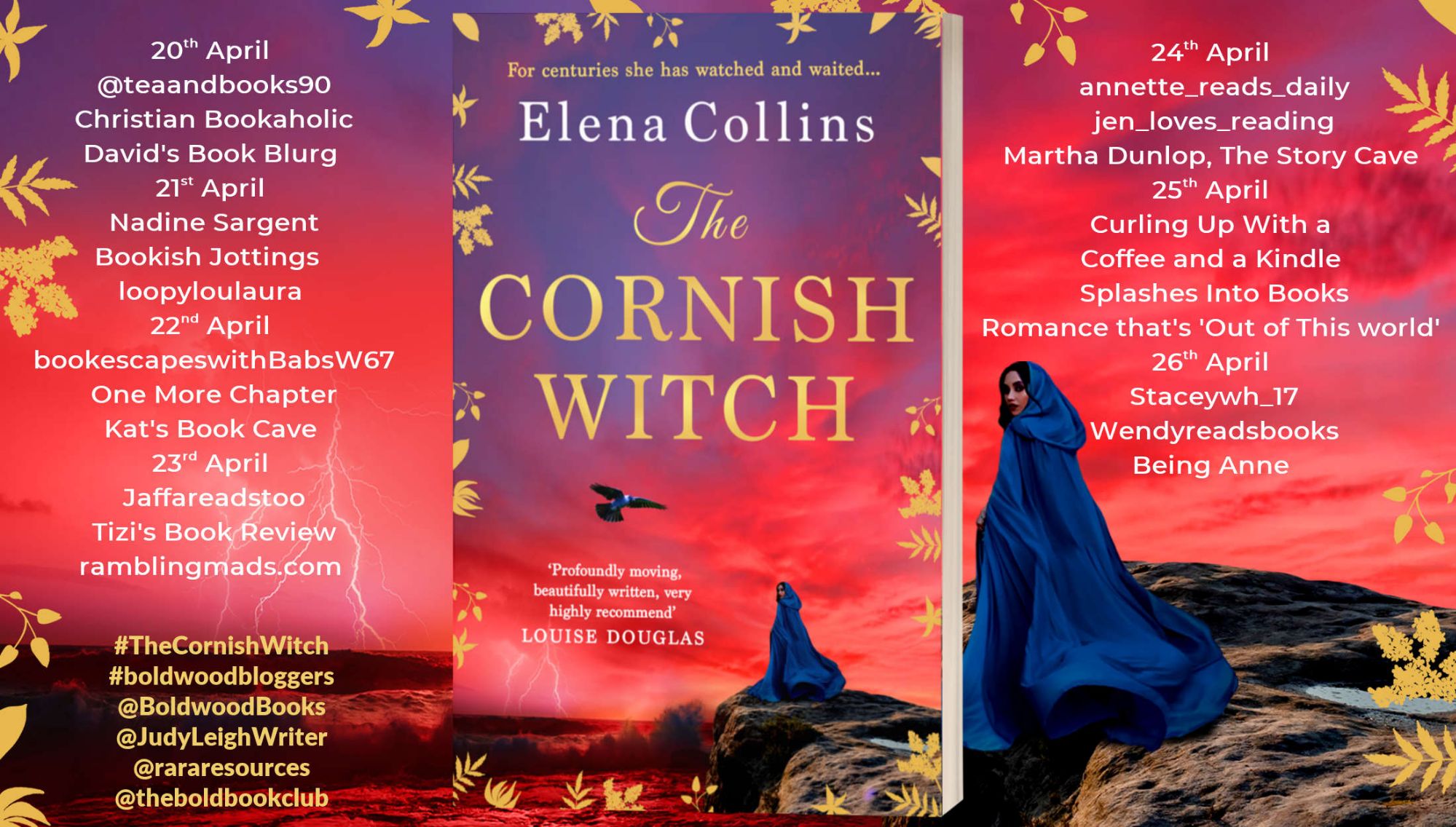
Now: When Megan’s father gets a letter containing a secret from the past, he asks her to go to the Cornish village of St Mawgen Cove to get to the bottom of the mystery. Megan is happy to take a holiday after a challenging year but as soon as she checks into The Ship Inn something feels amiss. There are noises in the room above, the locals tell tales of smugglers and shipwrecks and she can’t escape the story of the witch who waits and watches, weeping on the top of the cliff.
1625: Susanna and her daughter Katel live a contented life, but without the protection of a husband and father, Susanna fears for Katel’s future as she blossoms into womanhood. The fishing community of St Mawgen Cove is close knit but when misfortune arrives in the cove, it’s not long before villagers are looking for someone to blame. And when talk turns to witches, Susanna knows she and Katel are no longer safe.
Can Megan bring peace to St Mawgen and to two women who have been broken-hearted for centuries?
Leigh writes dual timeline stories under the name of Elena Collins: the name is a tribute to her grandmother who was a teller of stories and fortunes, and she had healing hands. These novels combine three of her passions: delving into rich historical tales, exploring stunning locations, and evoking the supernatural. They weave together stories of people’s lives both past and present, with some spine-tingling moments along the way. She loves writing these novels and hopes readers enjoy them as much as she does. The characters and settings are particularly close to her heart. Writing under the name of Judy Leigh, she is also the author of uplifting novels that explore the lives of older women and the possibilities of second chances, change, and happiness. Under this name, she writes the Morwenna Mutton/Seal Bay cozy crime series, set in Cornwall, featuring a sixty-something sleuth who enjoys solving crimes and getting into mischief. Outside of writing, Leigh enjoys traveling, reading, music, and theatre. She holds an MA in Professional Writing. When she’s not at her desk or spending time with her two black cats, she’s often researching her next novel in some of the country’s most beautiful locations and beyond.
My thoughts: The persecution of women seen as “witches” is a dark part of our national history, with people who had committed no crime tortured and executed on the say so of often bias and ignorant others.
Susanna is one of a long line of women who ministered to the sick, delivered babies and prepared the dead for burial. Her folk remedies and herbs probably saved some lives along the way, but all it takes is one tragic death after another for the villagers to start muttering and looking her way. Unmarried and with a daughter whose father she has never named, they’re instantly the suspects. What happens next will haunt the village for centuries, literally.
Megan runs a business selling herbal remedies and crystals, a sort of modern day version of Susanna. Drawn to St Magwen by a letter her father receives, she finds joy in the sea and the people she meets. She also finds relics of the darkest moments of its past, a weeping woman can be heard in one of the pub’s guest rooms, and a woman dressed in white haunts the clifftop. With the help of a few new friends, she decides to try to put the restless spirits to peace. She’s also looking for the half-sister she’s only just learnt about, a new relationship she’s keen to build.
Both women are unapologetically themselves, Susanna stands her ground until her world is shattered, and Megan’s open hearted, generous nature draws others to her, and helps her unlock the secrets of the past.
A really enjoyable and fascinating book with real heart and great characters. I was gripped from the start by the strong women in this book.
*I was kindly gifted a copy of this book in exchange for taking part in this blog tour, but all opinions remain my own.
Set during the uneasy shift from World War II to the Cold War, Fantaisie follows Jan Orlinski and Sophie Gordon as they fight for freedom, love, and truth across war-torn Europe. Jan’s mission as a pilot leads him into dangerous and murky territory, while Sophie is forced into a deadly game of espionage that lands her in a brutal Soviet prison.
Michael Kenneth Smith, best known for The Postwoman, continues his exploration of the personal cost of global conflict through historical fiction rooted in rich detail and emotional stakes.
The black sedan was still following them as they neared the airport, albeit at a distance. Jan decided whoever it was wanted to keep an eye on them but wasn’t looking for a confrontation. He glanced back again as Brian made a quick turn and then another. After four years in Matadi, he knew the city’s streets well. Soon, they were headed back across the bridge into the heart of town, the sedan no longer visible behind them. The sun beat down as Brian guided the truck through Matadi’s bustling streets, which smelled of exhaust and overripe fruit from market stalls and street vendors. He turned down narrow alleys twice, the truck’s tires screeching in protest.
Five minutes later, they pulled up to a small, tidy house in an affluent neighborhood.
“Come on,” Brian said. “We need to talk.”
They entered the house, mostly empty and neglected in contrast to its well-maintained exterior. Dust motes danced in shafts of sunlight, revealing bare patches where furniture once stood. In the kitchen, a mountain of dirty dishes teetered in the sink. Brian gestured to one of two wooden chairs. “Water?”
“Yes, please,” Jan said, taking a seat and accepting the glass. The water tasted brackish; he grimaced.
“Matadi water,” Brian said, wiping sweat from his brow. “Safe, but an acquired taste.”
Jan’s eyes fell on a large black box next to the refrigerator. It hummed softly, its face a maze of dials, switches, and blinking lights. An antenna poked out from behind it, disappearing through a small hole in the wall. A large radio? He pushed the glass away and folded his arms as Brian sat.
“First of all,” he said, “my name isn’t Brian Rich. Until recently, I worked for the Office of Strategic Services, or OSS. It was established in 1942 by President Roosevelt as America’s first centralized intelligence agency, created to coordinate espionage activities behind enemy lines during World War II. Our work in the Congo was part of a larger operation called the Alsos Mission. Alsos is Greek for ‘grove,’ which was General Groves’s codename—he was the head of the Manhattan Project.”
“The people who created the atomic bomb,” Jan said.
“Exactly. And Shinkolobwe is where the uranium came from.”
“Hold on,” Jan said, feeling numb. “Are you saying—”
Brian nodded. “That’s not cobalt ore you’ve been hauling. It’s uranium. We kept it from the Germans, though truthfully, they never seemed that interested. Our Alsos teams discovered their program was years behind ours. But the Russians, on the other hand…”
Jan drank more water, taste be damned. “The Russians? Is that why—”
“Why did they steal your cargo? Most likely. They want the bomb, Jan. They want to be a superpower. And now that Alsos has been disbanded and the OSS is being dissolved, replaced by something called the Central Intelligence Group, there’s a vacuum. The Soviets are rushing to fill it.”
“But wait,” Jan said. “What about Gerston? If he’s supplying the Russians, why would they need to steal my cargo?”
“That’s the question,” Brian said. “Maybe multiple entities are competing to be Russia’s supplier. Or maybe this Gerston is trying to keep the uranium out of Russian hands. Or maybe he’s working for another country that wants the bomb. We just don’t know.”
“Okay, so what now?” Jan asked, his voice hoarse.
Brian stood, pacing the small kitchen. “I’m sending an encrypted message to Washington. We should hear back by tomorrow. Until then, let’s get you back to the airport.”
Brian took an entirely different route this time, but no one seemed to be following them. As they pulled up to the C-47, he turned to Jan. “I’ll be back in the morning after I get word from Washington.”
As Brian’s truck disappeared into the distance, Jan slumped against the side of the C-47, its metal skin still hot from the day’s sun. He hoped Burundi had found a mechanic and would be back soon. He wanted to get home. He was done working for Gerston, that much he knew. In fact, he would have abandoned the man’s plane, but Jan had no other way home.
The African sun dipped below the horizon, painting the sky in brilliant hues of orange and purple. Jan climbed into the plane for the night. With his cargo stolen, nothing was left to guard, and there was no reason to sleep outside again under the plane’s wing. He supposed that was a silver lining. He was about to close the rear door when something across the tarmac caught his eye. He squinted into the gathering darkness and saw the black sedan, parked almost out of sight behind a dilapidated hangar. He pulled the door shut, locked it, and lay down with the revolver at his side.
My thoughts: This was a really interesting book, set during the Cold War, where Sophie, exiled from the UK after her father was exposed as a Nazi spy in WW2, is offered the chance for redemption if she works for MI6, then a fledgling agency, in Paris. Unfortunately she’s being watched by the Soviets, who are keen to also recruit her.
Meanwhile her boyfriend, and father to her daughter, Jan, a Polish pilot, has signed on to fly a mysterious cargo from the Congo to Paris, he’s told it’s cobalt from the mines, but there are several interested parties including the Americans and Soviets, that suggest it’s something else…
An intriguing and engaging book, with a fantastic hero in Jan, and a brave heroine in Sophie, as their lives diverge and Sophie becomes a prisoner, while Jan is stranded in the desert, returning to find her missing and launches an audacious plan to rescue her.
*I was kindly gifted a copy of this book in exchange for taking part in this blog tour, but all opinions remain my own.
She craved purpose. She found danger. Now, there may be no turning back.
Genevieve Sturbridge was never meant for a quiet life in the English countryside. Once an artist in the heart of London, now she spends her days in restless solitude, longing for the passion and purpose she once knew. But when a familiar figure from her past arrives with an urgent request, she is thrust into a perilous world of spies and a formula that could shift the balance of power between France and England.
The thrill of the chase is intoxicating—the cryptic clues hidden in plain sight, the challenge of ferreting secrets from dangerous opponents, the undeniable rush of being needed again. But with every step deeper into the mystery, the danger grows. Someone is watching. Someone ishunting. And the more she uncovers, the more she wonders: has she walked willingly into a trap?
Torn between exhilaration and fear, Genevieve must decide—was this the life she was always meant for, or has she risked everything for a mission that will consume her completely?
Years ago, protecting this secret nearly cost Genevieve her life. Now someone could be willing to kill for it once more.
If you tell Nancy Bilyeau that reading one of her historical novels of suspense is like strapping yourself into a time machine, you’ll make her day. She loves crafting immersive historical stories, whether it’s Jazz Age New York City in “The Orchid Hour,” the 18th-century European chateaus and porcelain workshops in “The Versailles Formula,” “The Blue,” and “The Fugitive Colours,” or Henry VIII’s tumultuous England in “The Crown,” “The Chalice,” and “The Tapestry.” For her Genevieve Planche novels–“The Versailles Formula,” The Blue” and “The Fugitive Colours”–she drew on her heritage to create a Huguenot heroine. Nancy is a direct descendant of Pierre Billiou, a French Huguenot who immigrated to what was then New Amsterdam (later New York City) in 1661. Nancy’s ancestor, Isaac, was born on the boat crossing the Atlantic. Pierre’s stone house is the third oldest house in New York State. Nancy’s mind is always in past centuries but she currently lives with her husband and two children in upstate New York. Her quest to cook the perfectly flavored cassoulet is ongoing.
My thoughts: I hadn’t read the previous books in this series before I read this, and while it isn’t essential to do so, it might help to understand the back story.
Genevieve is bored of her quiet, provincial life in the English countryside, summoned to her friend’s home in Twickenham, and invited to Sir Horace Walpole’s rather peculiar home, Strawberry Hill, to help unravel a mystery, fills her with hope for adventure and intrigue. She gets both.
Dispatched to Paris as Lady Jane Howard, she’s attempting to find out if a treaty, the treaty she and her husband are implicated in keeping, has been broken on the French side. But there is danger, and her life could be at risk if she isn’t very careful.
Smart, resourceful, intelligent and brave, Genevieve must outwit those who mean her harm to get the answers she seeks and safely return to her husband and son, even if it means giving up the possibility of more with the dashing Captain Howard.
I went back and read the previous books, which filled in the story of how Genevieve came to be married to a schoolteacher and buried out in the country, having lived a rather eventful life. I actually think she should return to it. She has the head for adventure and teaching local gentry’s bored wives how to paint water colours of flowers must be tedious in the extreme.
Very enjoyable and entertaining, studded with real life figures and events, during a particularly tumultuous time for both England and France.
*I was kindly gifted a copy of this book in exchange for taking part in this blog tour, but all opinions remain my own.















 ramblingmads