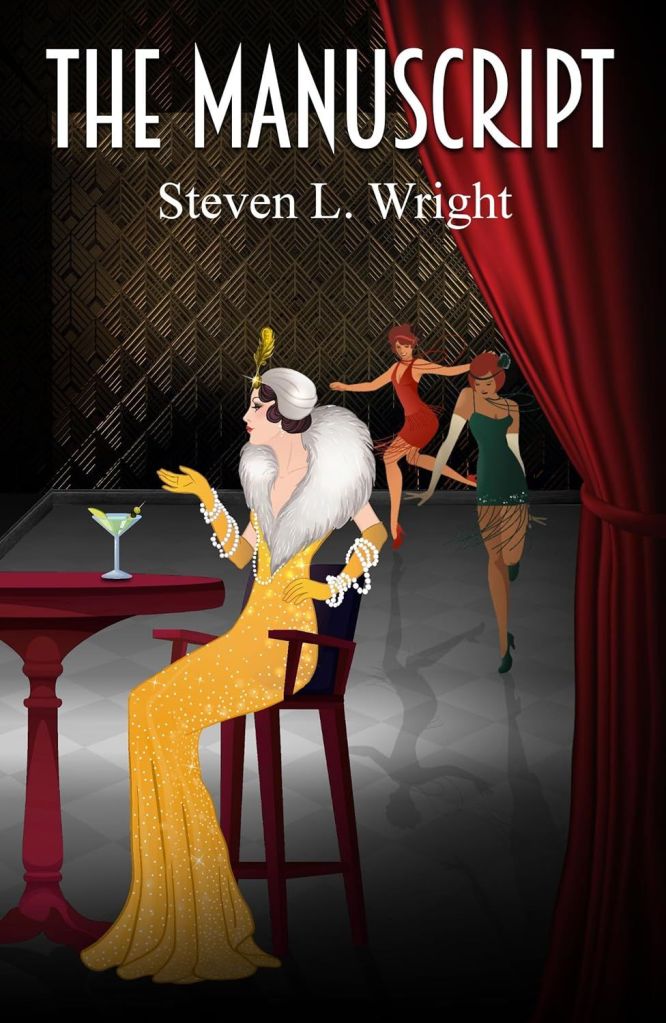
A newly married couple from Harrogate purchased a manuscript from an antiquarian bookseller titled, The Universal Language Isn’t Love or Music but Loneliness. Completed in 1940 by unknown author, William Travers, it was one of several items offered at the estate
auction of a local family. Reading and discussing the work changed their lives … and their marriage.
Waking in hospital Lieutenant William Travers learns the war’s over. The Armistice has been signed.
Physically wounded and emotionally crippled, Travers shuns convention and, armed with an alto saxophone, turns his back on America to remain in Paris. He’s a jazzman at heart, so a jazzman he’ll remain. Throughout the Roaring ‘20s and Lean ‘30s, he encounters a bevy of
characters: the artists of Montparnasse; the ladies at the Paris brothel; the curator at the Musee du Luxembourg; fellow band members in Paris; the stiff-collared Edwardians and the Bright Young Things who dance at London’s Savoy Hotel; the fiery Yorkshire sheep farmer who is half-American; the hard-bitten landlady in London; and, the owner of a Soho night club – the epicentre of everything considered illegal. On the eve of the Blitz in September 1940, he decided to perform one more gig.
A parallel narrative where the three protagonists, although separated by eighty years, confront the existential meaning of life.

Steve earned a BA and MA in history from the University of Cincinnati. After serving five years as a captain/attack helicopter pilot in the US Army’s 9th Infantry Division (1980-1985), he worked as a professional archivist and historian for twenty-five years. He has published several articles in peer-reviewed history journals in addition to three works of scholarly non-fiction including, Britain’s Battle to Go Modern: Confronting Architectural Modernisms, 1900-1925 published in 2018.
After relocating from London to the Yorkshire Dales National Park in 2014, he set himself a challenge: to write a work of fiction. His first attempt, Grey, Red, Blue … Gone was published in 2021. Steve enjoyed the process so he set his sights on a work of historical fiction hoping to incorporate his passion for history. The Manuscript is the culmination of years of research and
writing concerning the period in Paris and London known as the Jazz Age. An era when syncopated music nursed by cocktails comforted the bored and disillusioned and propelled the Bright Young Things toward an uninhibited lifestyle unknown to earlier generations.
Since his early days in secondary school, Steve has been interested in the lives and published works of several notable writers of the 1920s to the early 1940s, from F. Scott Fitzgerald and Richard Aldington to Ernest Hemingway and W. Somerset Maugham. He believes their work helped define those unique and troubling decades.
He still lives in the Yorkshire Dales National Park with his wife, Suzanne, a studio potter, whom he met twenty years ago at a Chicago jazz club, and a three-year-old rescue cat named Vesper.
My thoughts: The framing device of couple Fiona and Peter who have bought this mysterious manuscript allows the reader to feel as though they too are embarking on uncovering the mysteries about the document that forms the main body of this book.
Starting in the years after the First World War, the Manuscript is a memoir and philosophical meditation on life, love and loss. It’s author, William Travers, is the only survivor of his cohort of American airmen. Injured and alone, he has nothing to return to his hometown of Cincinnati for. Finding himself in Paris with his alto sax in hand, he sets himself up as a jazzman for hire.
Finding a small flat, a few paying gigs and eventually a lover, Veronique, he makes himself at home amongst the Roaring Twenties, the artists, musicians and other characters of the Left Bank. These are happy years, he joins a jazz band of fellow American ex-pats, serenades the ladies of a high class brothel, and befriends a British bartender who supplies him with free whisky.
When tragedy hits, he abandons this life for the Savoy in London and the turbulent years of the 1930s. The Bright Young Things, disaffected and outrageous, the Edwardians (my own great-grandparents are products of that time, my Grandad was born in 1930).
William meets the delightful Helena, only remaining child of her family’s sprawling farm in the Yorkshire Dales. She farms the sheep and contends with her broken hearted mother. Their romance brings a sparkle back to his life, but sadly it doesn’t last and here he starts to develop the philosophy that will rule the rest of his life and provide his memoir it’s title – The Universal Language isn’t Love or Music – it’s Loneliness. But then in 1940 as the Blitz begins, William disappears.
Peter becomes obsessed with finding out what became of William and how his memoir ended up in an estate sale in Harrogate. It begins to affect his marriage, as obsession can, and while he will find some answers, he might just lose his wife.
I found William’s story both moving and compelling, the interwar years are complicated and unlike any other time before or since. Huge loss of life brackets those years, and many of the people who lived then were profoundly affected by the social, political and financial shifts that took place. I studied the period in both Britain and German history, contrasting the two countries as they recovered from one devastating war and into the next.
William’s wartime experiences are never far from his mind, he struggles with survivors’ guilt and probably has PTSD, as well as his physical injury from being shot down in his plane. It colours everything he does and experiences, his relationships with women and friendships with other men. There were actually a couple of moments so gut-wrenchingly sad I actually teared up.
The writing is compelling and gripping, you are right there with William as he sees the newly built Cenotaph and rages at the loss of life, the pointless futility of war. It reminded me so much of the poetry of Wilfred Owen and Siegfried Sassoon, furious at the way so many were betrayed into giving their lives, and for what?

*I was kindly gifted a copy of this book in exchange for taking part in this blog tour, but all opinions remain my own.

 ramblingmads