The Bronze Age’s Most Relatable Detectives
Step into the sandals of Neferet and Bener-ib — two women doctors in ancient Egypt who never expected murder to become part of their medical routine. With the help of their perceptive teenage apprentice and Neferet’s steadfast father, this unlikely investigative team takes on crimes that shake their community to the core.
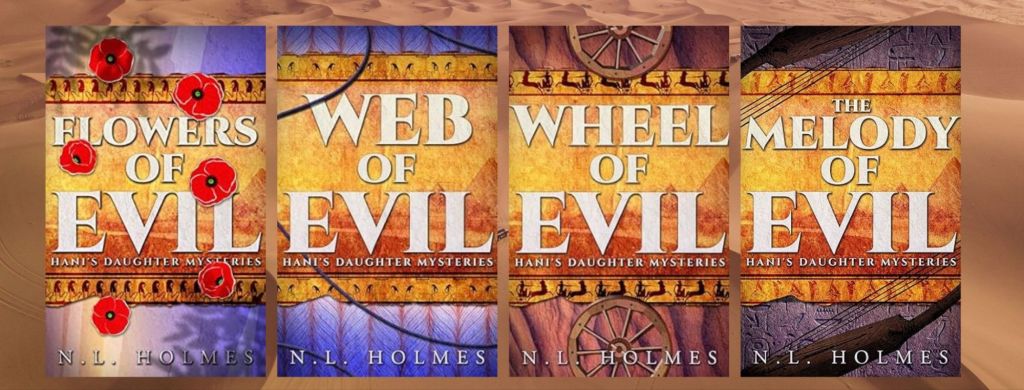
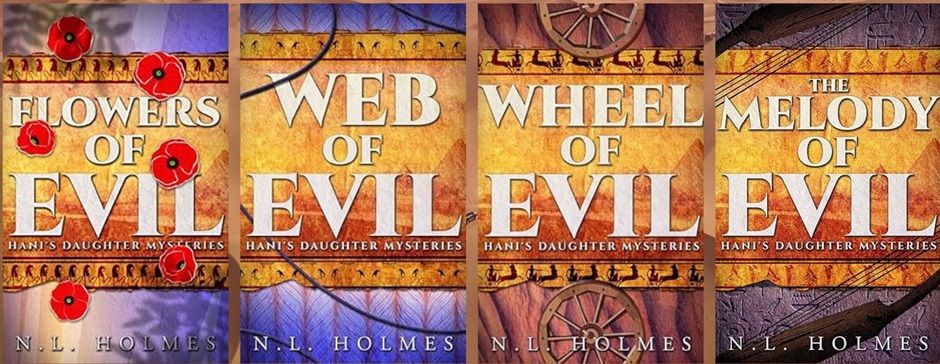
Across four rich, standalone books — Flowers of Evil, Web of Evil, Wheel of Evil, and The Melody of Evil — N.L. Holmes brings ancient Thebes to life through everyday lives touched by extraordinary events. There are no pyramids here — just humanity, heart, and a whole lot of suspense.
📖 Discover the series
📸 Follow the author

Women in Ancient Egypt
One of the things about ancient Egyptian society that inspired the character of Neferet is the status of their women. They were freer and more respected than in almost any other contemporary society, even though we’d have to admit that that society, like our own, was basically patriarchal. Apart from being honored as mothers, lovers, and helpmeets, women were legal majors, able to own property, testify in court, bring lawsuits, and conduct business under the same legal protections as men. They could sit on village councils, and we even have records of women who served as the mayor of their village. Although it was definitely the exception, they could rule the entire country in the person of a queen,.and these were very hands-on monarchs with few limits to their authority. In the Old Kingdom, Egypt’s formative period, at least one woman served as vizier or prime minister, and there were classes of priestesses that corresponded to almost every class of priest. Unfortunately, these opportunities for religious authority were restricted in later periods to women of the royal family.
The idea of a female vizier or priest raises the issue of whether women were literate. Only 1% of the population could read and write, and literacy was the key to social status. We have no positive testimony that this golden skill was confided to any but males. However… it’s hard to imagine a vizier who couldn’t read the reports that were brought to her. It’s difficult to conceive how the female stewards of large royal or private estates could supervise the running of palaces without being at least basically lettered. The same is true of female physicians—who did exist— since Egyptian medicine rested upon casebooks based on generations of trial and error. Thus, I think the case of our Neferet, whose menfolk are all literate scribes, isn’t improbable. There must have been women now and again who were trained by their fathers or brothers, even if they didn’t formally attend the scribal school conducted at the temple of Amen-Ra, the House of Life.
That’s why Neferet became the character she is: headstrong, pushy, and unconventional. She does a lot of things that wouldn’t have been common in her day but wouldn’t have been forbidden either. She was lucky enough to live in an age when women were strong and sometimes independent, visible, and fully able to contribute to their society in a variety of ways. She would have had those all-important role models. Some men might have disapproved of her, but others would have accepted her forwardness. And I think the great and proactive goddesses of Egypt’s pantheon would have looked on with affection.
Excerpt
“Can you do anything?” the woman cried tremulously, clutching at Neferet’s arm.
But Neferet could think of nothing encouraging to say. Her insides had that hollow, leaden feeling that meant the worst was about to happen.
“There’s no point in stitching up the outside,” she said gently. “He’s lost a lot of blood, and they’ve chopped him up pretty seriously inside. As the medical books say, ‘This is not a case I will treat.’”
The woman understood and began to whimper. She reached out a hand to touch her husband’s shoulder but then drew back as if she’d just discovered it was someone else. A gloomy silence fell over the group, broken only by the increasingly weak huff of the patient’s breath. His lips moved feebly, and Bener-ib leaned over his face.
“I think you’d better stand with him, mistress,” Neferet said. “His soul is ready to fly. He might have something to say to you.”
The woman drew closer fearfully. “Sen-em-iah, my brother, I’m here.”
At first, Neferet wondered if she’d misunderstood and the woman was really his sister—although from her age she might have been his daughter—but brother and sister were terms of endearment often used by married people. Everyone stood, hushed, waiting for a final word from the threshold of the other world. Sen-em-iah said nothing. His head lolled finally, and a tiny sibilance of breath escaped him.
They all stared at him expectantly until Neferet said in a quiet tone, “I think he’s passed to the West, mistress.”
She took the patient’s hand and pressed her fingers against the inside of the wrist. No pulse.
The woman stared at Neferet as if she couldn’t believe her. She made no move to wail or tear her hair.
“Who is he? Why might someone have done this?”
Since the wife was frozen, one of the servants answered. “Sen-em-iah son of Nakht is—was—Bearer of Divine Offerings of Amen, mistress. Chief florist of the Hidden One’s temple, like his father before him.”
Yahyah. That explains why he was just coming home at this hour of the morning. Florists work all night, while it’s cooler.
“Who would want to kill a florist?” she asked. “They don’t hurt anybody.”
“Maybe it was just a random attack,” suggested another of the servants. “Maybe they were going to rob the master.”
“Were you all with him when he was attacked?”
“Not me,” said an older man. “I’m the steward. I came out with the mistress of the house when the others yelled. These young fellows are the litter bearers and bodyguards. Yes, they were with him.”
No casual robber would have attacked anybody protected by eight stalwart young men. And Neferet knew what the servants didn’t—the attacker had not just stabbed Sen-em-iah but had ripped viciously. He had aimed to kill.
The steward said, “We brought him all the way here because we didn’t know where else a sunu could be found at this hour of the morning. One of these fellows lives in this neighborhood.”
Bener-ib, who had been listening intently, leaned over Sen-em-iah and drew down his eyelids.
That gesture brought his wife out of her shock, and she began to cry, quietly at first, but soon she was howling, keening, raking at her face with her nails.
“Perhaps mistress would like to go home, notify the children?” suggested the steward, taking her by the elbow. “If we could leave the master here briefly until we can call the servants of Inpu…?” He raised inquiring eyes to the two sunets, one after the other. Already, he was edging the distraught widow toward the door. The block of servants crowded after them.
“Of course,” said Neferet. “Is it all right if we come by later to ask a few questions? We’ll have to report this murder, now that we’re involved, and we’ll need to explain what we see’s been done to the body.”
The steward nodded distractedly over his shoulder, and the entire crowd disappeared through the door. The woman’s wails trailed off as they exited the gate, and soon Neferet, Bener-ib, and Mut-tuy were left staring at one another in silence. The young girl’s eyes were round as plates and scalpel sharp.
Mangler had entered and was lapping blood from the smooth plaster floor, his tail wagging in pleasure at the windfall.
Neferet gave her partner a long significant stare. “Do you realize what this is? Our first murder case.”
“Our first? Will there be more?” Bener-ib said faintly.
“Look at that wound. Somebody wanted to be sure this florist died. Somebody who knew what they were doing. A soldier, maybe. A professional assassin.” Neferet turned to the body of Sen-em-iah, whose eyes had popped open a slit. He seemed to be watching them. “If only he could tell us who did this. I feel sure he knew. But he didn’t have any final words.”
“Oh yes, he did,” said Bener-ib, brightening. “I distinctly heard him say something just before you called his wife over.”
Neferet’s heart stepped up its pace. She seized Bener-ib’s hand. “He did? Quick, Ibet! What did he say? This could be the clue to his murder!”
Bener-ib looked around as if searching for witnesses to support her, then she pronounced firmly in her girlish voice, “He said… he said, ‘Sekhat. Rabbit.’”
My thoughts: This series is so good, if you love crime fiction, historical fiction, strong female protagonists, loving families, adventure, cute animal sidekicks, it’s all here.
Hani is an important scribe working in the Egyptian empire for the boy king we know as Tutankhamen. His daughter, Neferet is a sunet or doctor, who along with her partner Bener-if (in life and medicine) provides medical treatment to the people and occasionally animals in their community. She has adopted a family of orphans, and is meant to be training one as her apprentice, only Mut-tay would rather be a detective.
When a man dies in their dispensary, Neferet takes it upon herself to investigate his murder and the series has her and her friends, as well as members of her family, look into suspicious deaths of various people from the community. Mostly people who would be overlooked as not important, like a florist, a musician, a scribe. The medjay (the police) are lazy and corrupt so if Neferet and Hani don’t look into things, no one else will and the dead will never get justice.
The books are really enjoyable and relatable, despite being set thousands of years in the past. The characters and their relationships are fully realised and I really rooted for them, to get justice and to be safe as they often come up against really nasty people. Luckily their canine bodyguard, Brute, is there to save them. There is a fifth book due later this year and I can’t wait!
*I was kindly gifted a copy of this book in exchange for taking part in this blog tour, but all opinions remain my own.

 ramblingmads